
Singapore real estate investment trusts (S-REITs) are investment vehicles structured as unit trusts that pool capital from investors to own and manage income-producing properties, operating under strict regulatory frameworks to ensure tax transparency and investor protection. The S-REIT framework legally separates asset ownership from day-to-day management, placing property assets under an independent trustee while a licensed REIT manager handles operations. Investors own units in the trust, not shares in a company. This distinction carries significant legal and financial consequences. The Monetary Authority of Singapore (MAS) governs the entire framework, mandating that S-REITs distribute at least 90% of taxable income annually to qualify for tax transparency treatment.
What is the Singapore real estate investment trust structure?
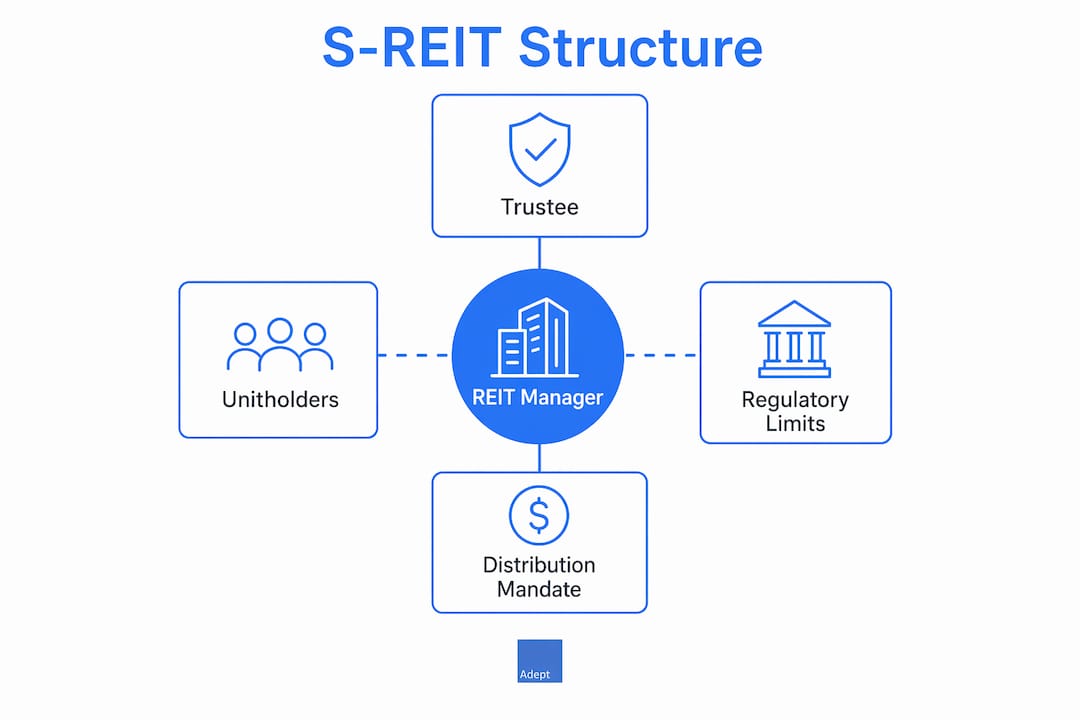
The S-REIT structure rests on three distinct parties: the trustee, the REIT manager, and the unitholders. Each plays a defined legal role, and the separation between them is the core feature that protects investors.

The trustee's role
The trustee holds all assets on behalf of unitholders. Assets are ring-fenced from the REIT manager, meaning that if the manager fails or is replaced, the properties remain protected. The trustee also monitors compliance with the trust deed and MAS regulations. This structure gives unitholders a layer of protection that shareholders in a standard company do not have.
The REIT manager's responsibilities
The REIT manager handles acquisitions, asset management, capital raising, and investor relations. Most S-REIT managers are externally managed subsidiaries of property developers or financial institutions. This external management model creates a potential conflict of interest. Manager fees are typically tied to assets under management, which can incentivize asset base growth over returns per unit. Investors should scrutinize fee structures carefully before committing capital.
Unitholder rights and fee structures
Unitholders receive regular income distributions and hold voting rights on major decisions, including the replacement of the REIT manager. Units trade on the Singapore Exchange (SGX), giving investors liquidity that direct property ownership cannot match. Fee structures typically include a base management fee, a performance fee, and an acquisition fee. Each fee layer reduces net distributions to unitholders, so understanding the total fee drag is part of sound due diligence. For a deeper look at how Singapore trust formation works, the legal framework governing S-REITs follows established trust law principles.
Pro Tip: When evaluating an S-REIT, calculate the total expense ratio including all manager fees, trustee fees, and financing costs. A high-yield REIT with excessive fees may deliver less net income than a lower-yield REIT with lean cost structures.
- Trustee: Holds assets, monitors compliance, acts in unitholder interests
- REIT manager: Manages operations, acquisitions, and capital allocation
- Unitholders: Receive distributions, vote on key resolutions, trade units on SGX
- Fee layers: Base fee, performance fee, acquisition fee, trustee fee
- Conflict risk: External managers may prioritize asset growth over per-unit returns
What are the regulatory and financial requirements for S-REITs?
MAS sets the financial guardrails that define how S-REITs operate. These rules directly affect income, leverage, and growth capacity.
The 90% distribution mandate
S-REITs must distribute at least 90% of taxable income each year to maintain tax transparency status. Under this regime, qualifying distributions to resident individual investors are exempt from Singapore personal income tax. The REIT itself also avoids corporate income tax on distributed income. This makes S-REITs one of the most tax-efficient property investment structures available in Singapore. For investors assessing investment holding structures, the tax treatment of S-REIT distributions differs materially from dividends received through a standard holding company.
Leverage limits and interest coverage
MAS caps aggregate gearing at 50% of total assets. The average sector gearing across S-REITs sits at approximately 39.1%, well below the regulatory ceiling. MAS also requires a minimum interest coverage ratio (ICR) of 1.5x. The sector average ICR stands at approximately 3.8x as of 2026. These dual guardrails, the gearing cap and the ICR floor, jointly limit financial risk at both the individual REIT and sector levels.
| Regulatory requirement | MAS limit | Sector average (2026) |
|---|---|---|
| Aggregate gearing | 50% maximum | ~39.1% |
| Interest coverage ratio | 1.5x minimum | ~3.8x |
| Income distribution | 90% minimum | Varies by REIT |
Pro Tip: An S-REIT trading near the 50% gearing cap has limited room to borrow for acquisitions. In a rising interest rate environment, that constraint becomes a material risk to distribution growth.
Capital raising implications
The 90% payout rule limits retained earnings. S-REITs depend on capital markets for growth, raising funds through rights issues, private placements, and new debt. This means unitholders face periodic dilution risk when equity is raised. The quality of each acquisition matters more than the volume of deals. Investors should assess whether each capital raise is accretive to distributions per unit, not just to total asset size.
How can investors access and invest in Singapore REITs?
Investing in S-REITs is accessible to both retail and institutional investors. The entry barriers are low compared to direct property ownership.
- Open a brokerage account linked to a CDP account. The Central Depository (CDP) holds your S-REIT units in Singapore. Most local and international brokerages offer SGX access.
- Select your S-REIT or REIT ETF. Approximately 40 S-REITs and stapled trusts are listed on SGX, with a combined market capitalization near S$100 billion. Sectors include industrial, retail, healthcare, office, and data centers.
- Assess minimum investment size. Units trade at approximately a few hundred Singapore dollars per lot, making diversified exposure achievable at modest capital levels compared to buying physical property.
- Choose between individual REITs and REIT ETFs. Individual S-REITs offer targeted sector exposure and higher potential yields. REIT ETFs provide instant diversification across multiple S-REITs but typically carry lower yields after ETF management fees.
- Evaluate distribution frequency and yield. Most S-REITs pay distributions quarterly or semi-annually. Yield levels vary by sector and leverage profile.
- Assess key risks before investing. External manager fee structures, gearing levels, interest rate sensitivity, and sponsor quality all affect long-term returns.
The REIT investment model delivers liquidity, diversification, and consistent income that direct real estate investment cannot replicate at the same capital outlay. That combination explains why S-REITs attract both income-focused retail investors and institutional allocators seeking regulated real estate exposure.
How do S-REITs grow their portfolios and distributions?
Growth in an S-REIT comes primarily from two sources: acquiring new assets and improving the income from existing ones. Both paths carry distinct risks.
Sponsor injections and acquisitions
Most S-REITs have a sponsor, typically the property developer or financial institution that established the trust. Sponsors inject assets into the REIT through sale-and-leaseback arrangements or direct acquisitions. Asset injection transactions require coordination among the trustee, REIT manager, sponsor, and legal advisors to address stamp duty treatment and ensure fair valuation. A REIT that consistently acquires assets from its sponsor at above-market valuations destroys unitholder value, even if total assets grow.
Capital markets dependence
Because the 90% distribution rule limits retained cash, S-REITs must return to capital markets repeatedly. Rights issues dilute existing unitholders unless the acquisition funded by the raise is sufficiently accretive. Debt financing is cheaper but pushes gearing higher, reducing future borrowing capacity. The best-managed S-REITs balance both tools, maintaining gearing well below the 50% cap to preserve financial flexibility.
- Accretive acquisitions: Distribution per unit rises after the deal closes
- Dilutive acquisitions: Asset size grows but per-unit income falls
- Organic growth: Rental reversions and occupancy improvements within existing assets
- Sponsor pipeline: Quality and depth of sponsor's undistributed asset pipeline matters
- Debt refinancing risk: Fixed-rate debt rolling over in a high-rate environment compresses margins
Evaluating growth quality requires looking beyond headline yield. A REIT that grows assets aggressively through dilutive equity raises may show rising total distributions while delivering declining distributions per unit. That distinction separates strong S-REIT managers from those simply building fee-generating asset bases.
Key Takeaways
The Singapore real estate investment trust structure delivers tax-efficient, liquid real estate exposure through a legally separated trustee-manager framework, mandatory 90% income distribution, and MAS-regulated leverage caps that jointly protect unitholder interests.
| Point | Details |
|---|---|
| Legal separation protects investors | Trustee holds assets independently from the manager, ring-fencing property even if the manager is replaced. |
| 90% distribution mandate drives tax efficiency | Qualifying distributions to resident individuals are exempt from personal income tax under MAS rules. |
| Gearing cap limits financial risk | MAS caps leverage at 50%; the sector average of 39.1% shows most REITs maintain a meaningful buffer. |
| Capital markets dependence is a structural feature | High payout ratios force S-REITs to raise equity or debt for growth, creating dilution risk with each capital raise. |
| Fee scrutiny is non-negotiable | External manager fee structures tied to assets under management can misalign manager incentives with unitholder returns. |
Our view on evaluating S-REITs as an investment
The most common mistake analysts make with S-REITs is treating yield as the primary evaluation metric. Yield is an output. The inputs that determine whether that yield is sustainable are trustee independence, fee structure, gearing headroom, and acquisition track record.
Trustee quality rarely gets the attention it deserves. A passive trustee that rubber-stamps manager decisions provides far less protection than one that actively monitors compliance and challenges related-party transactions. When reviewing an S-REIT, I look at the trustee's history of challenging the manager on valuation and fee matters. That track record is a better indicator of governance quality than any disclosure document.
The regulatory environment in 2026 continues to tighten. MAS has raised the bar on ICR requirements and disclosure standards. S-REITs that entered this cycle with gearing near 45% are now facing real constraints on acquisition capacity. That is not a temporary problem. It is a structural disadvantage that will compound if interest rates remain elevated.
For investors building a diversified portfolio, S-REITs earn a place as a core income allocation. The Singapore REIT framework is one of the most investor-protective in Asia, and the sector's depth across industrial, healthcare, and data center assets provides genuine diversification. The caution is this: do not let the regulatory framework substitute for your own due diligence on individual manager quality and acquisition discipline.
— Wandy & Terence
How Adept Corporate Services supports S-REIT participants
Structuring, launching, or managing an entity within the S-REIT ecosystem requires precise regulatory compliance from day one.
Adept Corporate Services works with REIT managers, trustees, and institutional investors across Singapore to address MAS licensing requirements, corporate secretarial compliance, and fund administration. Whether you are establishing a new management company, preparing for a MAS licensing application, or managing ongoing governance obligations, Adept Corporate Services provides direct, expert support without automated handoffs. The team's experience with corporate treasury services and regulatory compliance covers the full lifecycle of S-REIT operations. Contact Adept Corporate Services to discuss your specific structure and compliance requirements.
FAQ
What is the legal form of an S-REIT?
An S-REIT is structured as a unit trust under Singapore trust law, with assets held by an independent trustee on behalf of unitholders. Investors own units, not shares, which means asset ownership is legally separated from the REIT manager.
How much must S-REITs distribute to unitholders?
S-REITs must distribute at least 90% of taxable income annually to maintain tax transparency status. Qualifying distributions to resident individual investors are exempt from Singapore personal income tax.
What is the maximum gearing allowed for S-REITs?
MAS caps aggregate gearing at 50% of total assets. The sector average gearing as of 2026 sits at approximately 39.1%, with a minimum interest coverage ratio requirement of 1.5x.
How do I buy S-REIT units in Singapore?
Investors purchase S-REIT units through a brokerage account linked to a CDP account on SGX. Approximately 40 S-REITs and stapled trusts are listed, with minimum investment amounts accessible to retail investors at modest capital levels.
What are the main risks of investing in S-REITs?
The primary risks include interest rate sensitivity on leveraged portfolios, dilution from equity capital raises, and potential misalignment between external manager fee incentives and unitholder returns. Gearing levels and acquisition track records are the two most critical risk indicators to monitor.