
A business trust in Singapore is defined as a business enterprise structured as a trust arrangement, governed by the Business Trusts Act 2004, where a trustee-manager holds legal title to trust property on behalf of unitholders. Unlike a company incorporated under the Companies Act, a business trust lacks separate legal entity status, meaning the trustee-manager acts as principal in all legal and commercial dealings. The Monetary Authority of Singapore (MAS) regulates and supervises all registered business trusts, making this a well-defined but specialized structure within Singapore's capital markets framework. Understanding what a business trust in Singapore involves, including its governance, liabilities, and practical uses, is critical before committing to this structure over a conventional company.
How does a business trust differ from a company in Singapore?
The most fundamental distinction is legal status. A company registered under the Companies Act is a separate legal entity that can own property, sue, and be sued in its own name. A business trust has no such status under the Business Trusts Act. The trustee-manager holds all legal title to trust assets and enters into contracts personally, as principal, on behalf of the trust.
Governance structures also diverge sharply. Companies are governed by directors who owe duties to shareholders. In a business trust, the trustee-manager owes fiduciary duties directly to unitholders under both trust law and the Business Trusts Act. Unitholders hold beneficial interests in the trust property, not shares in a company. There are no directors or shareholders in the conventional corporate sense.

Liability treatment is where the difference becomes most consequential for anyone considering this structure. A company director's personal assets are generally protected by the corporate veil. A trustee-manager, by contrast, incurs personal liabilities for obligations assumed in its role, though it is entitled to indemnity from the trust property. This creates a distinct risk profile that demands careful due diligence before appointment.
Pro Tip: If you are comparing a business trust to a company for your specific use case, focus first on the liability and governance differences rather than tax treatment. The structural implications are more consequential and harder to reverse.
| Feature | Business Trust | Company |
|---|---|---|
| Legal entity status | None (trustee-manager acts as principal) | Separate legal entity |
| Governance | Trustee-manager with fiduciary duties | Board of directors |
| Ownership interests | Unitholders (beneficial interest) | Shareholders (equity) |
| Liability exposure | Trustee-manager personally liable, indemnified by trust property | Directors generally protected by corporate veil |
| Regulatory oversight | MAS under Business Trusts Act 2004 | ACRA under Companies Act |
What legal and regulatory requirements govern business trusts in Singapore?
The primary legislation is the Business Trusts Act 2004, which sets out registration requirements, governance obligations, and the legal framework for trustee-managers and unitholders. Business trusts must also comply with the Securities and Futures Act 2001, particularly where units are offered to the public or listed on an exchange. MAS serves as the primary regulator and maintains oversight of all registered business trusts in Singapore.
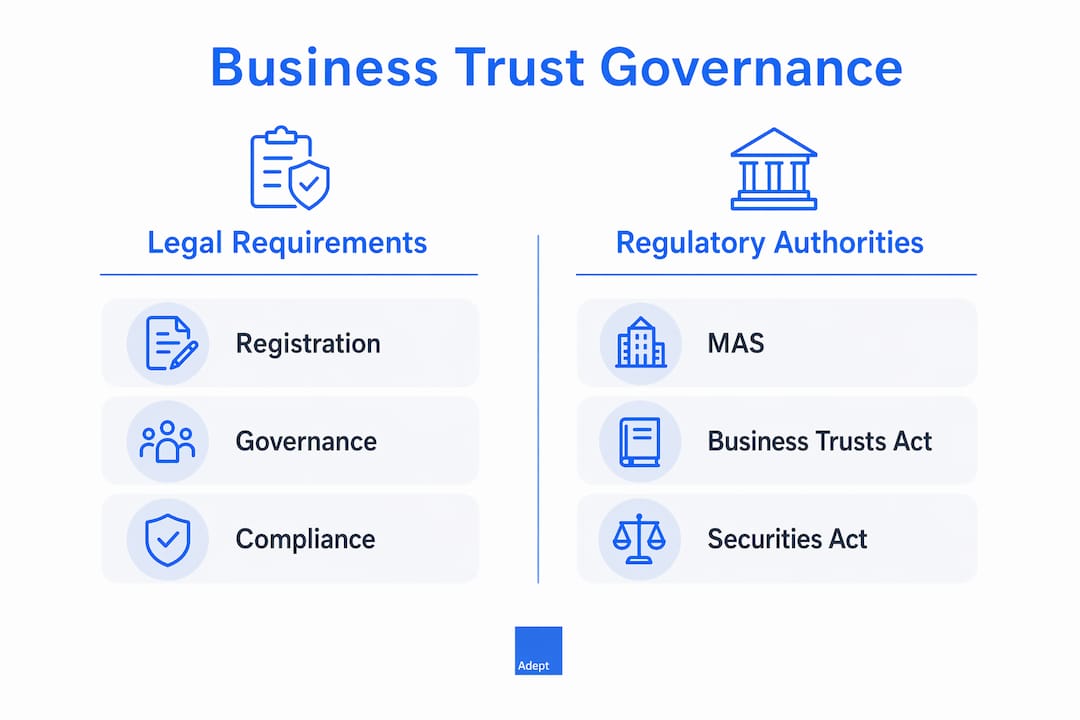
The governing document for any business trust is the trust deed. This deed defines the scope of the trustee-manager's powers, the rights of unitholders, distribution policies, and the conditions under which the trust can be wound up or restructured. Drafting the trust deed requires careful coordination between legal counsel and compliance advisors, as it must satisfy both the Business Trusts Act and MAS disclosure standards.
Key compliance requirements include:
- Registration with MAS as a registered business trust before any public offering of units
- Ongoing disclosure obligations covering material developments, financial results, and related-party transactions
- Governance standards requiring the trustee-manager to maintain independent directors and audit committees where applicable
- Annual reporting in line with MAS guidelines and applicable accounting standards
- Trust deed compliance with MAS-prescribed content requirements for registered business trusts
MAS publishes a public registry of 14 registered business trusts, including NetLink NBN Trust and CapitaLand Ascott Business Trust. This transparency signals that MAS treats registered business trusts as regulated capital market products, not informal arrangements. Sponsors and investors can verify registration status directly through the MAS website, which is a practical due diligence step before any transaction.
| Regulatory Requirement | Governing Authority | Key Obligation |
|---|---|---|
| Registration as business trust | MAS | Required before public offering of units |
| Trust deed compliance | MAS | Deed must meet prescribed content standards |
| Disclosure obligations | MAS / Securities and Futures Act | Ongoing material disclosure to unitholders |
| Governance standards | Business Trusts Act 2004 | Independent directors and audit committee |
| Annual financial reporting | MAS guidelines | Audited accounts and annual report |
Who manages a business trust and what are their responsibilities?
The trustee-manager is the legal owner and operational controller of a business trust. This entity holds trust property, enters into contracts, employs staff, and manages the business, all in its capacity as trustee-manager rather than as a separate corporate entity. Licensed trust companies typically perform this role, providing the regulatory safeguards that MAS requires for registered business trusts.
The fiduciary responsibilities of a trustee-manager are extensive. Under the Business Trusts Act and the trust deed, the trustee-manager must:
- Act in the best interests of unitholders at all times
- Avoid conflicts of interest or disclose them fully when they arise
- Maintain proper books of account and financial records
- Comply with all MAS disclosure and governance requirements
- Exercise the standard of care expected of a professional fiduciary
The liability position of a trustee-manager is one of the most technically complex aspects of this structure. The Singapore High Court confirmed in the Dasin Retail Trust case that liabilities incurred in a trustee-manager capacity are those of the trustee-manager personally, not of any separate trust entity. The trustee-manager is, however, entitled to indemnity from the trust property for those liabilities. This means creditors look first to the trustee-manager, who then seeks reimbursement from trust assets. The distinction matters enormously for creditors, unitholders, and the trustee-manager itself when financial distress arises.
Pro Tip: When selecting a trustee-manager, prioritize entities with a proven track record under MAS supervision and sufficient capital to absorb potential liability exposure before indemnity from trust property is realized. The selection decision carries more legal weight here than appointing a company director.
What are the advantages and potential challenges of a business trust?
Business trusts offer a distinct set of advantages for asset-backed investment structures and certain capital markets vehicles. The most cited benefit is distribution flexibility. Unlike companies, which can only distribute accounting profits, business trusts can distribute income from operating cash flow. This makes them particularly attractive for infrastructure, telecommunications, and hospitality assets that generate strong cash flows but carry significant depreciation charges.
Additional advantages include:
- Asset continuity: The trust structure provides continuity of ownership independent of changes in the trustee-manager, protecting unitholder interests through transitions
- Investor appeal: The mandatory distribution framework and MAS oversight create a transparent, regulated product that appeals to institutional and retail investors
- Separation of assets: Trust property is legally separated from the trustee-manager's own assets, providing a degree of protection for unitholders against the trustee-manager's insolvency
- Market access: Listing on the Singapore Exchange (SGX) as a business trust provides access to public capital markets, as demonstrated by NetLink NBN Trust and CapitaLand Ascott Business Trust
The challenges are equally real. The regulatory complexity of operating under both the Business Trusts Act and the Securities and Futures Act demands dedicated compliance resources. The trustee-manager's personal liability exposure, even with indemnity rights, creates a risk profile that deters some potential operators. Business trusts are also a less familiar structure than companies for many counterparties, which can complicate commercial negotiations and financing arrangements.
Business trusts are best suited to mature, cash-generating assets where predictable distributions are a key investor proposition. They are not typically the right structure for early-stage businesses or ventures with volatile cash flows.
How to create and register a business trust in Singapore
Establishing a business trust in Singapore follows a defined process with several non-negotiable steps. Skipping or shortcutting any of them creates regulatory exposure that MAS will not overlook.
- Draft the trust deed. Engage qualified legal counsel to prepare a trust deed that complies with MAS-prescribed requirements under the Business Trusts Act. The deed must cover the trustee-manager's powers, unitholder rights, distribution policy, and governance framework.
- Appoint a licensed trustee-manager. The trustee-manager must be a licensed trust company or an entity approved by MAS. This appointment is a regulatory prerequisite, not a commercial formality.
- Register with MAS. If units are to be offered to the public or listed on SGX, registration with MAS as a registered business trust is mandatory. The application requires submission of the trust deed, prospectus, and supporting governance documentation.
- Comply with Securities and Futures Act requirements. Public offerings require a prospectus registered with MAS, meeting all disclosure standards under the Securities and Futures Act.
- Establish ongoing compliance infrastructure. Post-registration, the trustee-manager must maintain systems for continuous disclosure, financial reporting, related-party transaction governance, and unitholder communications.
Pro Tip: Begin the trust deed drafting process at least six months before your intended launch date. MAS review timelines and the complexity of aligning the deed with both the Business Trusts Act and Securities and Futures Act requirements consistently catch first-time sponsors off guard.
Engaging a corporate services provider with experience in regulatory compliance in Singapore from the outset reduces the risk of costly amendments during the MAS review process. The investment in proper setup pays dividends in smoother ongoing administration.
Key takeaways
A business trust in Singapore is a regulated trust arrangement under the Business Trusts Act 2004, where the trustee-manager holds legal title and personal liability, making structure selection, trustee-manager appointment, and MAS compliance the three decisions that determine success or failure.
| Point | Details |
|---|---|
| No separate legal entity | The trustee-manager acts as principal; the trust itself cannot own property or sue independently. |
| Trustee-manager liability | Personal liability applies for trust obligations, with indemnity rights against trust property. |
| MAS registration required | Public offerings of units require registration with MAS under the Business Trusts Act 2004. |
| Distribution flexibility | Business trusts can distribute from operating cash flow, not just accounting profits. |
| Trustee-manager selection | Appoint a licensed trust company with MAS approval and sufficient capital for liability exposure. |
Why business trusts are more nuanced than most guides suggest
From our experience advising clients across corporate formation and fund structures in Singapore, the most common misconception about business trusts is that they function like companies with a different name. They do not. The absence of separate legal entity status is not a technicality. It fundamentally changes how contracts are entered, how liabilities are allocated, and how creditors recover in a distress scenario.
We have seen sponsors underestimate the trustee-manager selection process. Many treat it as an administrative step when it is, in fact, the most consequential governance decision in the entire structure. A trustee-manager with inadequate capital or insufficient compliance infrastructure creates systemic risk for the entire trust, not just for itself.
The Dasin Retail Trust case is instructive here. The court's ruling on personal liability confirmed what the statute says but what many practitioners gloss over in client briefings. The indemnity from trust property is a right, not a guarantee of recovery. If trust assets are insufficient, the trustee-manager bears the residual exposure.
We also observe that business trusts are increasingly used in Singapore's infrastructure and digital connectivity sectors, with NetLink NBN Trust being the clearest example of a structure purpose-built for stable, regulated asset cash flows. For sponsors considering this route, the regulatory discipline required is significant, but the capital markets access and distribution flexibility it unlocks are genuinely differentiated from what a company structure offers.
If you are weighing a business trust against a company or investment holding structure, the decision should be driven by your asset profile, investor base, and distribution objectives, not by a preference for one legal form over another.
— Wandy & Terence
How Adept Corporate Services can help you structure and manage a business trust
Setting up a business trust in Singapore requires precise legal drafting, MAS registration expertise, and ongoing compliance management that goes well beyond standard company formation. Adept Corporate Services provides end-to-end support for clients navigating this process, from initial structure assessment through trust deed review, MAS filing coordination, and post-registration corporate secretarial compliance. Our team works directly with clients, without automated handoffs, to manage the regulatory requirements that determine whether a business trust operates smoothly or faces avoidable enforcement exposure. For clients also evaluating company formation alongside a trust structure, our business formation services cover the full spectrum of Singapore corporate structures. Contact Adept Corporate Services directly for a consultation tailored to your specific structure and objectives.
FAQ
What is a business trust in Singapore?
A business trust in Singapore is a trust arrangement governed by the Business Trusts Act 2004, where a trustee-manager holds legal title to trust assets and operates the business for the benefit of unitholders. It is not a separate legal entity and is regulated by MAS.
How does a business trust differ from a company?
A company is a separate legal entity with directors and shareholders, while a business trust has no separate legal entity status. The trustee-manager holds legal title and incurs personal liabilities for trust obligations, indemnified by trust property.
Do business trusts pay income tax in Singapore?
Business trusts are generally taxed at the trustee-manager level on income derived from trust operations, with distributions to unitholders treated differently depending on the nature of the income. Tax treatment should be confirmed with a qualified Singapore tax advisor for each specific structure.
Who regulates business trusts in Singapore?
MAS regulates business trusts under the Business Trusts Act 2004 and the Securities and Futures Act 2001. MAS maintains a public registry of all registered business trusts, which currently includes 14 entities such as NetLink NBN Trust and CapitaLand Ascott Business Trust.
What are the main steps to register a business trust in Singapore?
Registration requires drafting a compliant trust deed, appointing a licensed trustee-manager, and submitting a registration application to MAS before any public offering of units. Ongoing compliance with MAS disclosure and governance requirements applies after registration.
Recommended
- Starting and Setting Up a Business or Company in Singapore | Adept Corporate Services
- What foreigners must know about setting up a company in Singapore | Adept Corporate Services
- Setting Up a Company in Singapore for a Foreigner: A Step-by-Step Guide | Adept Corporate Services
- US Founders' Guide to Singapore Tax | Adept Corporate Services