
Ease of doing business in Singapore is defined as the degree to which the country's regulatory framework allows entrepreneurs to start, operate, and grow a company with minimal friction. Singapore ranks 1st in Southeast Asia and 11th globally in the Savills 2026 Nearshoring Index for business environment. That standing reflects a combination of digitized incorporation processes, a transparent legal system, competitive tax rates, and a government that actively courts foreign investment. For entrepreneurs evaluating where to base their Asia-Pacific operations, understanding what is ease of doing business in Singapore means looking beyond the headline rankings to the specific regulatory mechanics that drive them.
What makes Singapore's business environment so attractive?
Singapore's business climate earns its reputation through measurable efficiency, not just favorable policy language. Company incorporation can be completed in as little as 1.5 days through the Accounting and Corporate Regulatory Authority's fully digitized platform. That speed is a direct result of Singapore's investment in e-government infrastructure over the past two decades.
The legal system reinforces this efficiency. Singapore operates under English common law, which provides legal certainty for contract enforcement and dispute resolution. The country consistently scores at the top of Transparency International's Corruption Perceptions Index, making it one of the least corrupt jurisdictions in Asia. For foreign investors, that transparency reduces the due diligence burden significantly.

The government's pro-enterprise stance goes beyond low barriers to entry. The Economic Development Board and Enterprise Singapore administer grants, tax incentives, and co-investment schemes targeting startups and small and medium enterprises. Singapore's corporate tax rate is capped at 17%, and the country has signed over 90 comprehensive double taxation agreements, giving businesses clear pathways to manage cross-border tax exposure.
Key factors driving Singapore's business-friendly reputation include:
- Digitized incorporation: The entire registration process runs through BizFile+, the Accounting and Corporate Regulatory Authority's online portal.
- Free trade agreements: Singapore maintains one of the world's most extensive free trade agreement networks, covering major economies across Asia, Europe, and the Americas.
- Foreign ownership: Foreign investors face no restrictions on ownership in most sectors, with swift incorporation timeframes and a free enterprise economy.
- Stable political environment: Singapore's government provides consistent, long-term policy direction, which reduces regulatory uncertainty for businesses planning multi-year investments.
- Intellectual property protection: Singapore ranks among the top jurisdictions globally for IP protection, which matters for technology and pharmaceutical companies.
Pro Tip: If you are evaluating Singapore against other APAC locations, request a side-by-side comparison of effective tax rates after incentives, not just headline corporate tax rates. Singapore's incentive programs often reduce the effective rate well below 17% for qualifying activities.
How does Singapore compare to other Asia-Pacific business destinations?
Singapore ranks as the 6th least complex business destination in the Asia-Pacific region. New Zealand, Hong Kong, Thailand, Vietnam, and Taiwan all rank ahead of it on complexity metrics. That ranking reflects a specific finding: Singapore's strict anti-money laundering regulations and labor laws add measurable compliance weight that simpler jurisdictions do not impose.
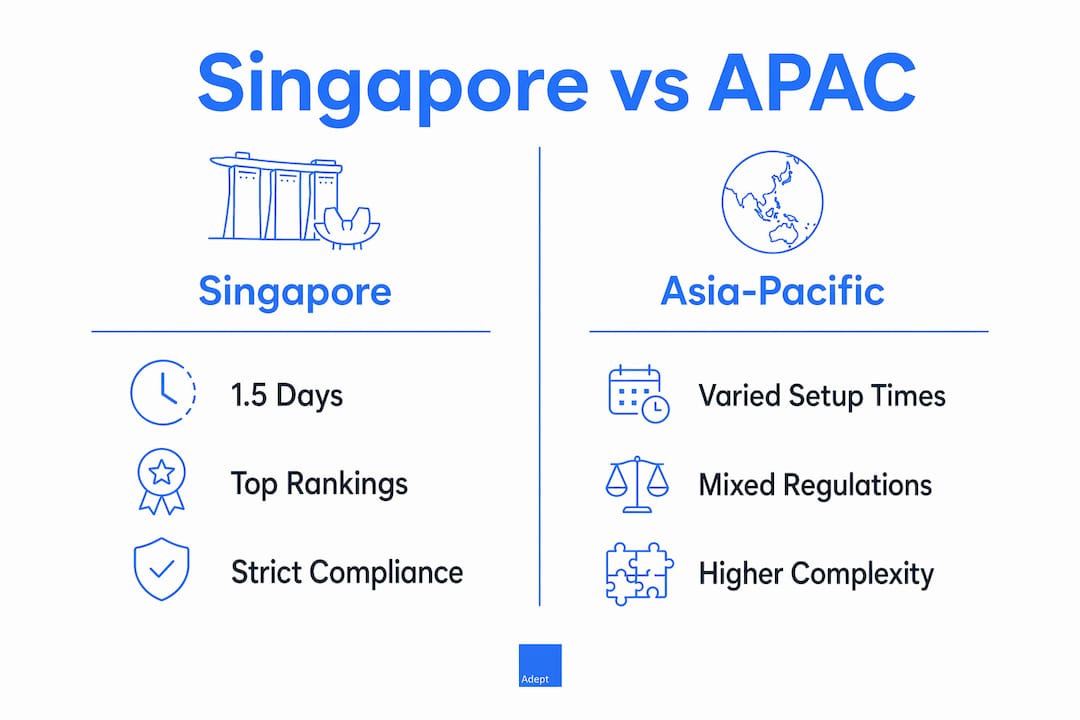
The table below compares Singapore against key APAC peers on the dimensions that matter most to entrepreneurs:
| Dimension | Singapore | Hong Kong | New Zealand |
|---|---|---|---|
| Incorporation speed | 1.5 days | 1–3 days | 1 day |
| Corporate tax rate | 17% (max) | 16.5% (max) | 28% |
| Foreign ownership | Unrestricted (most sectors) | Unrestricted | Unrestricted |
| AML compliance burden | High | High | Moderate |
| Labor law complexity | High | Moderate | Moderate |
| Free trade agreements | 90+ | 20+ | 15+ |
Singapore's labor regulations are particularly demanding. Employers must comply with mandatory CPF contributions, foreign manpower quotas, and employment contract requirements. Itemized payslips must be issued within 14 days of each pay period. HR records must be maintained with precision and are subject to Ministry of Manpower audits.
The anti-money laundering framework adds another layer. Singapore's Monetary Authority of Singapore enforces rigorous know-your-customer and beneficial ownership disclosure requirements. These apply not just to financial institutions but to corporate service providers and, increasingly, to operating companies with complex ownership structures.
Compliance obligations that entrepreneurs frequently underestimate include:
- Annual returns filed with the Accounting and Corporate Regulatory Authority
- Audited financial statements for companies above statutory thresholds
- Goods and Services Tax registration once annual turnover exceeds S$1 million
- Foreign worker levy payments tied to dependency ratio ceilings
- Flexible work arrangement policies, which became mandatory in 2024
Pro Tip: Track your 2026 compliance calendar from day one. Missing a single filing deadline with the Accounting and Corporate Regulatory Authority can trigger penalties and, in serious cases, director disqualification.
What practical steps should entrepreneurs take to set up in Singapore?
The business setup process in Singapore follows a clear sequence, but each step carries decisions with long-term consequences. Rushing through entity selection is the most common and costly mistake entrepreneurs make.
-
Choose the right legal entity. The three main options are a private limited company (subsidiary), a branch office, and a representative office. A subsidiary is a separate legal entity, which limits liability and qualifies for most government grants. A branch office is an extension of the foreign parent, which means the parent bears full legal liability for Singapore operations. A representative office cannot generate revenue and is limited to market research activities. Entity structure decisions affect tax exposure, liability, and grant eligibility, so professional advisory is not optional.
-
Register with the Accounting and Corporate Regulatory Authority. The registration process runs through BizFile+. You will need a company name, a registered Singapore address, at least one locally resident director, and a company secretary appointed within six months of incorporation. The filing fee is nominal.
-
Appoint a corporate secretary. Singapore law requires every company to maintain a qualified corporate secretary. This person manages statutory filings, maintains the register of members and directors, and ensures the company meets its annual compliance obligations.
-
Open a corporate bank account. This step is where timelines extend significantly. Full operational readiness after registration often takes weeks because banks conduct risk assessments tied to beneficial owner nationality, business activity, and source of funds. Entrepreneurs from higher-risk jurisdictions should budget additional time and prepare thorough due diligence documentation. Adept Corporate Services provides bank account opening support to help clients navigate this process.
-
Register for tax and employment obligations. Once operational, you must register with the Inland Revenue Authority of Singapore for corporate tax purposes. If you hire staff, CPF registration is mandatory before the first payroll cycle. Foreign employees require valid work passes before commencing employment.
-
Understand ongoing compliance. Annual corporate tax returns, annual general meetings, and statutory filings with the Accounting and Corporate Regulatory Authority are recurring obligations. Companies with employees must also comply with the Employment Act, which governs leave entitlements, termination procedures, and payslip requirements.
Foreign entrepreneurs should read the guide for foreign founders before proceeding. The nuances around director residency requirements and nominee arrangements are frequently misunderstood and can delay incorporation.
What are common misconceptions about Singapore's ease of doing business?
The most persistent misconception is that ease of doing business means low compliance costs. Singapore's regulatory environment is efficient, but it is not light. Multinational enterprises absorb compliance costs more easily than smaller firms because they have dedicated legal and finance teams. A solo founder or a lean startup will feel the weight of Singapore's compliance requirements more acutely.
The second misconception is that Singapore's regulations are static. The government updates its regulatory framework regularly, and 2024 and 2025 brought significant changes to flexible work arrangement policies, beneficial ownership disclosure requirements, and anti-money laundering obligations for corporate service providers. Entrepreneurs who set up and then disengage from compliance monitoring face real risk.
"Singapore's regulatory environment is designed not just to reduce rules, but to apply thoughtful regulations that encourage innovation while protecting public interests." — Economic Development Board of Singapore
Business sentiment data supports a more nuanced picture. 69% of surveyed firms reported positive business sentiment in H1 2026, the lowest reading in three years. Rising costs and geopolitical tensions were the primary drivers of that decline. Singapore's open economy makes it sensitive to global trade disruptions, and entrepreneurs should factor that exposure into their planning.
The balanced approach Singapore takes is visible in sector-specific regulation. The government legalized cultivated meat while maintaining strict food safety standards, a decision that attracted significant food technology investment while protecting public health. That pattern repeats across fintech, biomedical, and digital asset sectors. Singapore opens doors that other jurisdictions keep closed, but it attaches clear compliance conditions to those opportunities.
Key Takeaways
Singapore's ease of doing business is defined by fast incorporation and transparent regulation, but sustained success requires proactive compliance management from day one.
| Point | Details |
|---|---|
| Top regional ranking | Singapore ranks 1st in Southeast Asia and 11th globally for business environment in the Savills 2026 index. |
| Fast but not frictionless | Incorporation takes 1.5 days, but full operational readiness including banking can take several weeks. |
| Compliance costs are real | Labor laws, AML requirements, and annual filings create meaningful compliance burdens, especially for smaller firms. |
| Entity choice is critical | Subsidiary, branch, and representative office structures carry different tax, liability, and grant eligibility implications. |
| Business sentiment is shifting | 69% of firms reported positive sentiment in H1 2026, the lowest in three years, driven by rising costs and geopolitical pressure. |
Singapore's ease of doing business: what the rankings don't tell you
Singapore's reputation as a business-friendly destination is well-earned, but the rankings create a false sense of simplicity. After working with hundreds of entrepreneurs and corporate clients setting up in Singapore, the pattern is clear: the companies that thrive here are the ones that treat compliance as a foundation, not an afterthought.
Entity selection is where most founders lose time and money. A branch office sounds appealing because it avoids the need to capitalize a new entity, but the parent company's unlimited liability exposure is a serious risk that becomes apparent only when something goes wrong. A subsidiary costs more to set up properly, but it protects the parent and qualifies for Enterprise Singapore grants that can offset those costs substantially.
Singapore's diplomatic neutrality is an underappreciated asset. The country maintains strong trade relationships with both the United States and China, which makes it a genuinely neutral base for businesses that need to operate across that divide. That neutrality is not guaranteed, but Singapore's track record of managing geopolitical relationships pragmatically gives it durability that few other jurisdictions can match.
The advice I give every client is this: invest two weeks in getting the structure right before you file anything. Understand your tax position, your grant eligibility, your banking requirements, and your employment obligations. Singapore rewards preparation. It penalizes shortcuts.
— Wandy & Terence
How Adept Corporate Services supports your Singapore setup
Setting up in Singapore correctly from the start requires more than filing the right forms.
Adept Corporate Services provides end-to-end support for entrepreneurs and corporate clients entering the Singapore market. From company registration and entity structuring to corporate secretarial compliance, tax filing, and bank account opening, the team handles the full scope of setup and ongoing obligations. Every client works directly with experienced professionals. No chatbots, no automated responses. Adept Corporate Services also supports regulatory compliance for companies navigating Singapore's anti-money laundering requirements, employment law obligations, and Monetary Authority of Singapore licensing. Contact the team to discuss your specific structure and timeline.
FAQ
What is ease of doing business in Singapore?
Ease of doing business in Singapore refers to how efficiently entrepreneurs can start, operate, and grow a company within Singapore's regulatory framework. Singapore ranks 1st in Southeast Asia and 11th globally in the Savills 2026 Nearshoring Index for business environment.
How long does it take to register a company in Singapore?
Company incorporation in Singapore can be completed in as little as 1.5 days through the Accounting and Corporate Regulatory Authority's BizFile+ portal. Full operational readiness, including bank account opening, typically takes several additional weeks due to risk assessments.
What are the main compliance obligations for Singapore companies?
Singapore companies must file annual returns with the Accounting and Corporate Regulatory Authority, maintain a qualified corporate secretary, comply with CPF contribution requirements for employees, and meet Goods and Services Tax registration thresholds once annual turnover exceeds S$1 million.
Is Singapore easy for foreign entrepreneurs to set up a business?
Foreign investors face no ownership restrictions in most sectors and can incorporate quickly. However, at least one locally resident director is required, and bank account opening timelines vary based on beneficial owner nationality and risk profile.
Why does Singapore rank 6th in APAC complexity rather than 1st?
Singapore ranks 6th least complex in APAC because its strict anti-money laundering regulations and labor laws add compliance weight that simpler jurisdictions like New Zealand and Hong Kong do not impose to the same degree. That complexity is the cost of operating in a highly regulated, high-trust environment.