
If you're weighing why expand business to Singapore against other regional options, the answer goes well beyond a favorable tax rate. Singapore sits at the intersection of East and West, functioning as the entry point to a 660-million-person Southeast Asian market while offering the legal predictability of a G7 economy. This guide breaks down the real strategic reasons businesses choose Singapore, from its innovation ecosystem and talent depth to the phased expansion framework that gets you from market testing to full operations without betting everything at once.
Table of Contents
- Key Takeaways
- Why expand business to Singapore: the real case
- Talent and innovation that actually scale
- Practical steps for expanding into Singapore
- Government support that reduces expansion risk
- Risks and considerations to plan for
- My perspective on getting Singapore expansion right
- How Adept-cs can support your Singapore expansion
- FAQ
Key Takeaways
| Point | Details |
|---|---|
| Strategic location advantage | Singapore connects you to Southeast Asia's 660-million-person market with world-class infrastructure and political stability. |
| Phased entry reduces risk | Start with a representative office for market testing before committing to full operations and regulatory compliance. |
| Government support is substantial | Budget 2026 offers up to 70% grants for SMEs and enhanced tax rebates to support overseas expansion. |
| Talent and innovation access | Singapore's RIE 2030 plan backs a S$37 billion investment in R&D, giving expanding businesses access to a deep tech talent pool. |
| Entity choice shapes your outcome | Matching your business structure to your expansion stage, from representative office to private limited company, is critical to early success. |
Why expand business to Singapore: the real case
Most people assume Singapore attracts foreign businesses because of low corporate taxes. The tax regime is genuinely competitive, with a headline rate of 17%, but that framing undersells what the city-state actually offers. Siemens, for instance, chose Singapore for supply-chain resilience and talent access, not labor cost arbitrage. Their digital factory investment reflects a deliberate decision to anchor advanced manufacturing capabilities in a stable, well-connected hub.
Singapore's strengths as a business hub break down across four dimensions that matter to any serious expansion:
- Market access: Singapore's free trade agreements with over 25 countries give businesses preferential access to markets across APAC, the EU, and the Americas.
- Political and legal stability: Transparent rule of law, strong intellectual property protection, and a corruption-free regulatory environment reduce the operational uncertainty that plagues other emerging market entries.
- Tax efficiency: Beyond the 17% headline rate, new and expanding businesses can access partial tax exemptions that bring effective rates on initial profits well below that figure.
- Infrastructure: Changi Airport connects Singapore to over 100 countries. The port handles over 37 million TEUs annually, making it one of the world's busiest container hubs.
The collaborative ecosystem of government agencies, global corporations, and specialized service providers creates a network effect that individual market advantages alone cannot replicate. If you're building a regional headquarters, that network cuts years off your learning curve.
Talent and innovation that actually scale
Singapore's workforce is trilingual, STEM-educated, and deeply familiar with cross-border business. But the talent story runs deeper than the local labor pool. The government's RIE 2030 framework channels S$37 billion into research and innovation, and over 4,500 tech startups currently operate out of Singapore. That density creates a talent market where engineers, data scientists, and product specialists have already worked with global firms and understand scale.
For businesses in manufacturing, biotech, fintech, or advanced logistics, this matters enormously. Partnerships with A*STAR, Singapore's national R&D agency, give foreign businesses access to applied research capabilities that would cost far more to build in-house. The government actively incentivizes these co-innovation arrangements.
Embedding local talent and building university partnerships are what separate businesses that genuinely scale from those that just maintain a Singapore address. Companies that treat the talent ecosystem as a supply chain input, rather than a recruiting afterthought, grow faster and adapt more effectively to regional market shifts.
Pro Tip: Before hiring your first Singapore-based employee, map which government-linked workforce development programs apply to your industry. The SkillsFuture Enterprise Credit and Workforce Singapore schemes can significantly offset training and onboarding costs for qualifying hires.
You also benefit from Singapore's multicultural population. A team fluent in English, Mandarin, Malay, and Tamil can manage client relationships across Singapore, Indonesia, Malaysia, China, and India without the communication friction that typically slows regional expansion.
Practical steps for expanding into Singapore
Understanding the benefits is one thing. Knowing how to actually move through the expansion process is where most businesses lose time. A phased approach works best: test first, then commit.
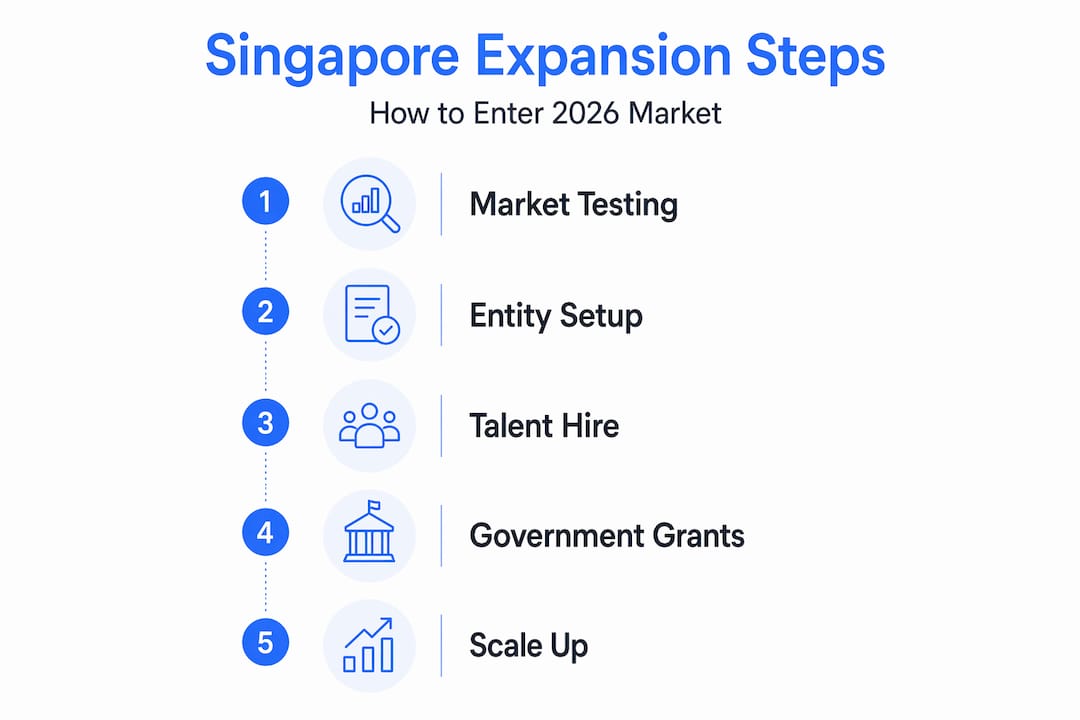
Here are the five stages that experienced advisors recommend:
- Market testing via representative office. A representative office lets you gauge demand and build relationships before full commitment. It cannot generate revenue, but it gives you ground-level intelligence without full regulatory exposure.
- Choose your business structure. The private limited company (Pte. Ltd.) is the most common vehicle for foreign businesses. You register with ACRA, Singapore's corporate regulator, and the process can be completed in one to three days online.
- Address regulatory compliance. Depending on your industry, you may need MAS licensing, sector-specific permits, or GST registration. Getting this sorted before you recruit is critical.
- Build your team. Singapore's Employment Pass system allows foreign professionals to work locally. For entrepreneurs, the EntrePass visa provides a one-year renewable work authorization specifically designed for foreign founders establishing a business base.
- Access financing and grants. Enterprise Singapore and EDB both offer programs that can fund expansion costs, subsidize hiring, and cover capability development.
Pro Tip: If you are a foreign entrepreneur without a local director, Singapore law requires at least one ordinarily resident director for your company. Many businesses solve this through a nominee director arrangement while they secure their own employment pass. Adept-cs handles this regularly for clients setting up from overseas.
| Expansion Stage | Entity Type | Key Consideration |
|---|---|---|
| Market testing | Representative office | Cannot earn revenue; limited to research and liaison activities |
| Early operations | Branch office or Pte. Ltd. | Pte. Ltd. preferred for liability protection and tax advantages |
| Full regional hub | Private limited company | Full compliance, ACRA registered, eligible for all incentive programs |
| Long-term presence | Permanent establishment | Consider PR pathways for key staff and permanent financing arrangements |
If you want more detail on what setting up actually involves, the Singapore company formation guide from Adept-cs covers the full structure of formation choices and compliance requirements.
Government support that reduces expansion risk
Singapore's government does not just create favorable conditions and step back. It actively funds overseas expansion through a set of programs that have grown more generous in recent years.

Budget 2026 delivered a corporate tax rebate and significantly enhanced grant schemes, with qualifying SMEs able to receive up to 70% co-funding on eligible overseas expansion activities. That is not a minor subsidy. For a business spending $500,000 on market entry, that represents $350,000 in direct government support.
Key programs worth knowing:
- Double Tax Deduction for Internationalisation (DTDi): Allows businesses to claim 200% tax deduction on qualifying expenses related to market expansion, including overseas trade shows, business development trips, and market feasibility studies.
- Enterprise Development Grant (EDG): Covers capability development, innovation, and market access projects.
- Enterprise Financing Scheme (EFS): Provides government-backed loan guarantees to help businesses access working capital for overseas growth.
"Overseas expansion is increasingly seen not as an optional growth move but as a resilience strategy. 8 in 10 local SMEs plan overseas expansion in 2026, driven by the need to diversify revenue and reduce home-market concentration risk."
For foreign businesses entering Singapore, these programs are equally accessible once your entity is registered and operating. The compliance piece matters here. You need clean books, timely corporate secretarial filings, and accurate tax returns to remain eligible. That is not difficult, but it requires attention from day one.
Risks and considerations to plan for
No expansion is without friction. Singapore-specific risks are manageable, but worth naming directly before you commit:
- Cost pressure: Office space, professional salaries, and compliance costs in Singapore run higher than most Southeast Asian markets. Budget accordingly and do not underestimate the staffing costs of a proper compliance function.
- Supply chain exposure: Post-COVID, many businesses learned that a Singapore hub does not automatically mean supply chain resilience. You need diversified supplier relationships across the region, not just a Singapore address.
- Local market nuances: Singapore's domestic market is small. If you expand expecting Singapore consumers alone to drive revenue, you will be disappointed. The opportunity is regional, not local.
- Entity-stage mismatch: Choosing a branch office when you need a Pte. Ltd., or jumping straight to a full operation when a representative office would do, creates unnecessary compliance burden and cost.
Choosing Singapore as a hub for ecosystem access and resilience, rather than cost leadership, consistently produces better long-term outcomes. Companies that enter with a cost-reduction thesis often restructure within 18 months. Companies that enter with a market-access and talent thesis tend to scale.
My perspective on getting Singapore expansion right
I've worked with dozens of businesses thinking through their Singapore expansion, and the pattern I see repeatedly is the same. Companies that succeed treat Singapore as an ecosystem play, not a tax play.
What I've learned from watching both successes and failures is that the businesses which struggle are almost always the ones that set up quickly, hire a small team, and then realize they have no idea how to tap the government programs, the talent networks, or the innovation partnerships that make Singapore genuinely different. They end up with an expensive address and not much else.
My strong view is that a staged expansion, as described in this guide, is not just prudent. It is genuinely the only way to build durable operations here. The representative office phase is underused because executives see it as slow. In practice, the businesses that spend three to six months in that phase almost always build better foundations than those who rush to a full registration.
I'd also push back on anyone who tells you the compliance burden in Singapore is trivial. It is manageable, but only if you treat it seriously from day one. Clean corporate secretarial records, accurate tax filings, and proper employment pass documentation are not optional extras. They are the foundation your future growth sits on. Cutting corners early costs you far more in remediation later.
What gives me real confidence in Singapore as a long-term base is not the tax rate or even the location. It is the quality of the collaborative business ecosystem and the government's consistent willingness to back businesses that are genuinely building here, rather than just parking assets.
— Terence
How Adept-cs can support your Singapore expansion
If you are at the point of seriously considering a Singapore operation, the practical questions pile up fast. What structure fits your stage? Who handles ongoing compliance? How do you stay current with corporate secretarial obligations while also running a business?
Adept-cs specializes in exactly this transition. From company registration and corporate secretarial services to tax compliance, payroll, and MAS licensing support, the team handles the operational scaffolding so you can focus on building your market. Every client reaches a real person. No chatbots, no automated holding emails, no outsourced queue. That matters more than it sounds when you are navigating an unfamiliar regulatory environment for the first time. Adept-cs also supports bank account opening for newly incorporated entities, which is one of the most consistently underestimated friction points in a Singapore setup.
FAQ
Why is Singapore considered a top business hub?
Singapore offers political stability, transparent rule of law, a competitive tax regime, and direct access to Southeast Asian markets, making it one of the most commercially secure expansion destinations in the world.
What are the first steps to expand business into Singapore?
The recommended first step is establishing a representative office for market testing, followed by ACRA registration of your preferred business entity, typically a private limited company, before moving to hiring and financing.
What government grants are available for businesses expanding to Singapore?
Budget 2026 enhanced grants cover up to 70% of eligible overseas expansion expenses for qualifying SMEs, alongside the Double Tax Deduction for Internationalisation and the Enterprise Financing Scheme for loan guarantees.
Can foreign entrepreneurs get a visa to operate in Singapore?
Yes. The EntrePass visa is specifically designed for foreign entrepreneurs and provides a one-year renewable work authorization to establish and run a business in Singapore.
Is Singapore's corporate tax rate really competitive?
Singapore's headline corporate tax rate is 17%, and new businesses benefit from partial tax exemptions that reduce the effective rate significantly in early profitable years, making it one of the most favorable structures in the Asia-Pacific region.
Recommended
- Why Singapore is the Best Place to Start a Company as a Foreigner in 2025 | Adept Corporate Services
- Singapore Single Family Office 2026 Guide | Adept Corporate Services
- Starting and Setting Up a Business or Company in Singapore | Adept Corporate Services
- Launch Your Fund in Singapore: The Ultimate Gateway to Asia’s Wealth Hub | Adept Corporate Services