
Singapore is defined as one of the world's most competitive destinations for foreign direct investment, combining policy stability, a comprehensive tax treaty network, and world-class infrastructure that no other Southeast Asian jurisdiction replicates at scale. The city-state attracted S$14.2 billion in fixed-asset investment commitments in 2025, up from S$13.5 billion in 2024, with AI-related manufacturing and global corporate headquarters driving the increase. Understanding why Singapore attracts foreign investment requires examining not just headline incentives, but the institutional architecture that makes execution certainty possible for investors deploying capital across Asia.
Why Singapore attracts foreign investment: the policy and economic case
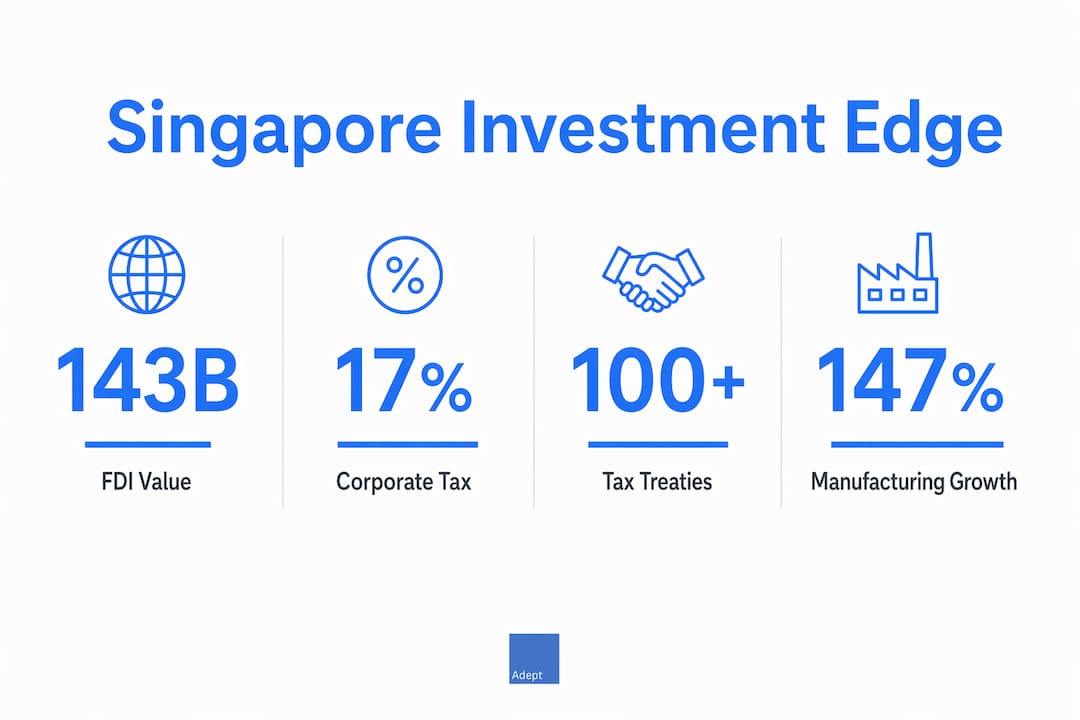
Singapore's corporate tax framework is the starting point for most investment analyses. The headline corporate tax rate stands at 17%, but the effective rate for qualifying activities drops considerably through incentive programs administered by the Economic Development Board (EDB). The Pioneer Certificate incentive grants a reduced or zero tax rate for companies introducing new activities or technologies to Singapore. The Intellectual Property Development Incentive (IDI) provides concessionary rates on qualifying IP income. Both programs are aligned with OECD substance requirements, meaning structures built around them withstand international scrutiny.

Singapore's open economy stance is equally deliberate. Foreign companies with substantive business activities are welcome to establish here, provided they comply with local laws and regulations. This is not a passive welcome. The EDB actively courts investors in advanced manufacturing, digital infrastructure, and financial services, offering co-investment frameworks and talent development partnerships that reduce setup friction. The result is a foreign investment climate in Singapore where regulatory expectations are high but entirely predictable.
The jurisdiction also functions as a natural gateway for regional expansion. Multinationals use Singapore to coordinate governance, treasury, and compliance across ASEAN from a single legal base. This reduces the operational complexity of managing multiple regulatory environments simultaneously, which is a material cost saving for any organization operating across Vietnam, Indonesia, Thailand, and the Philippines.
- Pioneer Certificate Incentive: Zero or reduced tax rate for companies introducing qualifying new activities
- Intellectual Property Development Incentive: Concessionary tax rates on income derived from qualifying IP
- Investment Allowance: Capital expenditure deductions for approved projects
- Global Trader Programme: Concessionary tax rates for qualifying commodity trading activities
- Financial Sector Incentive: Reduced rates for licensed financial institutions conducting qualifying activities
Pro Tip: When evaluating Singapore investment opportunities, request a pre-application consultation with the EDB before committing to a structure. The EDB's willingness to engage directly with investors during the planning phase is a differentiator that most jurisdictions do not offer.
How does Singapore's institutional stability support investor confidence?
Institutional credibility is the factor that separates Singapore from every other ASEAN economy competing for foreign capital. Singapore's currency is viewed as an anchor of macro discipline, and the Monetary Authority of Singapore (MAS) manages exchange rate policy with a consistency that gives investors a reliable macro reference point. This matters most during periods of regional volatility, when capital tends to concentrate in jurisdictions with credible central institutions.
"Singapore's credibility, policy stability, strong institutions, and deep trade and financial connectivity reduce perceived investment risk in ways that headline incentives alone cannot replicate." — CNBC analysis of Singapore's investment appeal
Governance quality reinforces this picture. Singapore ranks highly in global fraud resilience and maintains mature financial markets with deep liquidity across equities, bonds, and foreign exchange. The Singapore Exchange (SGX) provides a credible listing venue for regional companies, and the legal system operates on English common law principles, which reduces contract enforcement uncertainty for foreign investors accustomed to common law jurisdictions.
The financial connectivity dimension is often underestimated. Singapore's position as a hub for trade finance, private banking, and asset management means that capital deployed here has access to sophisticated financial services infrastructure. For investors structuring cross-border transactions, this translates directly into lower transaction costs and faster execution. The benefits of investing in Singapore extend well beyond tax efficiency into the operational reliability of the financial ecosystem itself.
Why do investors prefer Singapore over other Asian economies?
The standard assumption is that investors choose Asian locations primarily on labor cost. Singapore disproves this at scale. Siemens' €200 million digital factory investment in Singapore was driven by skilled talent availability, supply-chain resilience, and access to an advanced manufacturing ecosystem, not by wage arbitrage. This investment decision reflects a broader pattern among sophisticated multinationals that prioritize execution quality over input cost minimization.
The comparison below illustrates how Singapore positions itself relative to other regional investment destinations across the factors that matter most to institutional investors.
| Factor | Singapore | Regional alternatives |
|---|---|---|
| Corporate tax rate | 17% (effective rate lower with incentives) | 20–25% with fewer incentive structures |
| Legal system | English common law, independent judiciary | Civil law or hybrid systems with variable enforcement |
| IP protection | Strong statutory and treaty-based protection | Inconsistent enforcement in several jurisdictions |
| Talent pool | High-skilled, multilingual, STEM-focused | Variable quality; skills gaps in advanced manufacturing |
| Infrastructure | World-class port, airport, digital connectivity | Developing in most ASEAN peers |
| Political risk | Very low | Moderate to high in several markets |
Advanced manufacturers value Singapore for high-value capabilities and innovation ecosystems rather than lowest-cost labor. This is a structural advantage that compounds over time. As global supply chains shift toward resilience and quality over pure cost efficiency, Singapore's value proposition strengthens relative to lower-cost alternatives.
Singapore's record US$143 billion in FDI in 2024 included a 147% year-on-year surge in manufacturing FDI and a doubling of digital-related greenfield investments to US$16 billion. These figures confirm that the value-over-cost thesis is not theoretical. Investors are allocating capital to Singapore at record levels precisely because the ecosystem delivers returns that lower-cost locations cannot match.
Pro Tip: When benchmarking Singapore against other ASEAN locations, include the cost of regulatory uncertainty and contract enforcement risk in your analysis. These factors rarely appear in headline cost comparisons but materially affect after-tax returns over a five-year investment horizon.
How does Singapore's tax treaty network benefit foreign investors?
Singapore maintains over 100 comprehensive Avoidance of Double Taxation treaties, covering most of its major trading and investment partners. These treaties reduce withholding taxes on dividends, interest, and royalties flowing between Singapore and treaty partners, directly improving after-tax returns for investors using Singapore as a holding or operating company location. The predictability of treaty benefits, backed by Singapore's strong treaty compliance record, makes cross-border tax planning defensible under both domestic and international standards.
The incentive architecture complements the treaty network. The table below summarizes the primary fund management incentives available under Section 13 of the Income Tax Act.
| Incentive scheme | Qualifying fund type | Key benefit |
|---|---|---|
| Section 13O | Singapore-incorporated fund | Tax exemption on specified income |
| Section 13D | Offshore fund | Tax exemption on specified income |
| Section 13U | Large fund (min. AUM S$50 million) | Tax exemption with enhanced flexibility |
Fund management incentives under Section 13 attract family offices and investment funds by providing tax certainty and operational substance benefits. The minimum asset under management threshold for Section 13U and the requirement to deploy a portion of assets locally align incentive access with genuine economic activity, which satisfies OECD anti-avoidance standards. This alignment is critical for multinational investors who need their Singapore structures to withstand scrutiny from home-country tax authorities.
Cross-border investment structures in Singapore commonly combine tax treaties, incentive regimes, and substance-based rules compliant with OECD standards to ensure tax efficiency and defensibility. For family offices and asset managers, this combination creates a predictable, long-term operating environment that few competing jurisdictions can match.
What practical steps should investors consider when using Singapore as a regional hub?
Investors deploying capital through Singapore benefit most when they treat the jurisdiction as a regional operating control plane rather than simply a holding company location. This means centralizing treasury, compliance, and governance functions in Singapore while deploying operational activities across ASEAN markets. The practical steps below reflect the sequence that experienced investors follow when establishing a Singapore base.
-
Define the investment mandate clearly. Determine whether Singapore will function as a holding company, regional headquarters, trading entity, or fund management vehicle. Each structure has different licensing, substance, and tax implications.
-
Assess substance requirements early. Singapore's incentive regimes and tax treaties require genuine economic substance. This means local directors, qualified staff, and decision-making activity conducted in Singapore. Substance planning should begin before incorporation, not after.
-
Align timing with global industry cycles. Investment demand forecasting should incorporate global industry cycles, particularly AI chip manufacturing and digital infrastructure trends, rather than relying solely on Singapore's macroeconomic indicators. The 2025 investment surge was partly driven by AI-related demand, and investors who positioned early captured better incentive terms.
-
Engage with the EDB and MAS proactively. Both agencies offer pre-establishment engagement programs. For fund managers, MAS licensing timelines and capital requirements should be factored into the setup schedule from the outset.
-
Partner with a qualified corporate services provider. Navigating company formation, corporate secretarial compliance, tax filing, and work visa applications simultaneously requires coordinated expertise. A provider with direct knowledge of Singapore's regulatory environment reduces setup time and compliance risk materially. Adept Corporate Services offers company formation and compliance support specifically structured for foreign investors entering the Singapore market.
-
Build a compliance calendar from day one. Singapore's regulatory environment is predictable but demanding. Annual returns, tax filings, transfer pricing documentation, and MAS reporting obligations all carry deadlines that, if missed, attract penalties and reputational risk.
Key takeaways
Singapore attracts foreign investment because it combines institutional credibility, a comprehensive tax treaty network, and world-class infrastructure in a single jurisdiction that no ASEAN competitor replicates at equivalent scale.
| Point | Details |
|---|---|
| Investment scale | Singapore attracted S$14.2 billion in fixed-asset commitments in 2025, with AI manufacturing as the primary driver. |
| Tax architecture | Over 100 double taxation treaties and incentives like the Pioneer Certificate reduce effective tax rates for qualifying investors. |
| Institutional stability | Strong governance, English common law, and MAS credibility reduce perceived risk and support execution certainty. |
| Value over cost | Siemens' €200 million digital factory investment confirms that skilled talent and supply-chain resilience outweigh labor cost savings. |
| Regional hub function | Singapore serves as a regional operating base for ASEAN governance, treasury, and compliance from a single jurisdiction. |
Singapore's edge is structural, not circumstantial
From our experience working with foreign investors across multiple sectors, the question we hear most often is not whether Singapore is attractive. It is whether the advantages are durable. Our view is that they are, and for reasons that go beyond the incentive brochures.
What investors often overlook is that Singapore's edge is structural. The legal system, the MAS regulatory framework, the depth of the financial services ecosystem, and the quality of the talent pool are not policy choices that change with an election cycle. They are institutional assets built over decades. When global uncertainty rises, capital does not flee Singapore. It concentrates here, precisely because the governance architecture holds.
The AI-driven investment surge of 2024 and 2025 is instructive. Singapore did not win those commitments by offering the lowest cost. It won them because investors needed a jurisdiction where complex, high-value manufacturing and data infrastructure projects could be executed with confidence. That is a different kind of competitive advantage, and it is one that compounds as global supply chains continue to prioritize resilience.
What we advise investors to watch closely is the intersection of Singapore's incentive renewal cycles and OECD Pillar Two implementation. The global minimum tax framework is reshaping how multinationals structure their Singapore operations, and investors who engage with this proactively will be better positioned than those who treat it as a compliance afterthought.
— Wandy & Terence
How Adept Corporate Services supports your Singapore investment
Adept Corporate Services works directly with foreign investors and multinationals to establish and maintain compliant, tax-efficient corporate structures in Singapore. From company registration and corporate secretarial compliance to tax filing, MAS licensing support, and bank account opening for both local and offshore entities, the team at Adept Corporate Services covers the full setup and ongoing compliance lifecycle. Every client works with real people, not automated systems, which means your questions get answered by professionals who understand Singapore's regulatory environment in depth. For investors who want to move efficiently from decision to operation, Adept Corporate Services provides the corporate treasury and setup services that make that transition structured and compliant from day one.
FAQ
Why does Singapore attract more FDI than other ASEAN economies?
Singapore combines institutional credibility, English common law, over 100 double taxation treaties, and world-class infrastructure in a single jurisdiction. These factors reduce investment risk and execution uncertainty in ways that lower-cost ASEAN alternatives cannot replicate.
What tax incentives are available to foreign investors in Singapore?
The Pioneer Certificate, Intellectual Property Development Incentive, and Section 13 fund management exemptions are the primary incentive regimes. Each requires genuine economic substance and compliance with OECD standards to qualify.
Is Singapore suitable as a regional headquarters for ASEAN operations?
Singapore is the preferred regional headquarters location for multinationals operating across ASEAN, functioning as a centralized base for treasury, governance, and compliance. Significant intraregional investment flows, particularly in digital infrastructure, originate from Singapore-based entities.
How does Singapore's tax treaty network benefit cross-border investors?
Singapore's 100-plus tax treaties reduce withholding taxes on dividends, interest, and royalties, improving after-tax returns for investors using Singapore as a holding or operating company location. Treaty benefits are defensible under both domestic and OECD standards when supported by genuine substance.
What is the first step for a foreign investor setting up in Singapore?
Define the investment mandate and corporate structure before incorporation, then engage with the EDB and a qualified corporate services provider to align substance, licensing, and compliance requirements from the outset. Adept Corporate Services offers direct advisory support for investors at this stage through its Singapore company formation services.
Recommended
- Why Singapore is the Best Place to Start a Company as a Foreigner in 2025 | Adept Corporate Services
- Setting Up a Company in Singapore for a Foreigner: A Step-by-Step Guide | Adept Corporate Services
- Singapore Single Family Office 2026 Guide | Adept Corporate Services
- Launch Your Fund in Singapore: The Ultimate Gateway to Asia’s Wealth Hub | Adept Corporate Services