
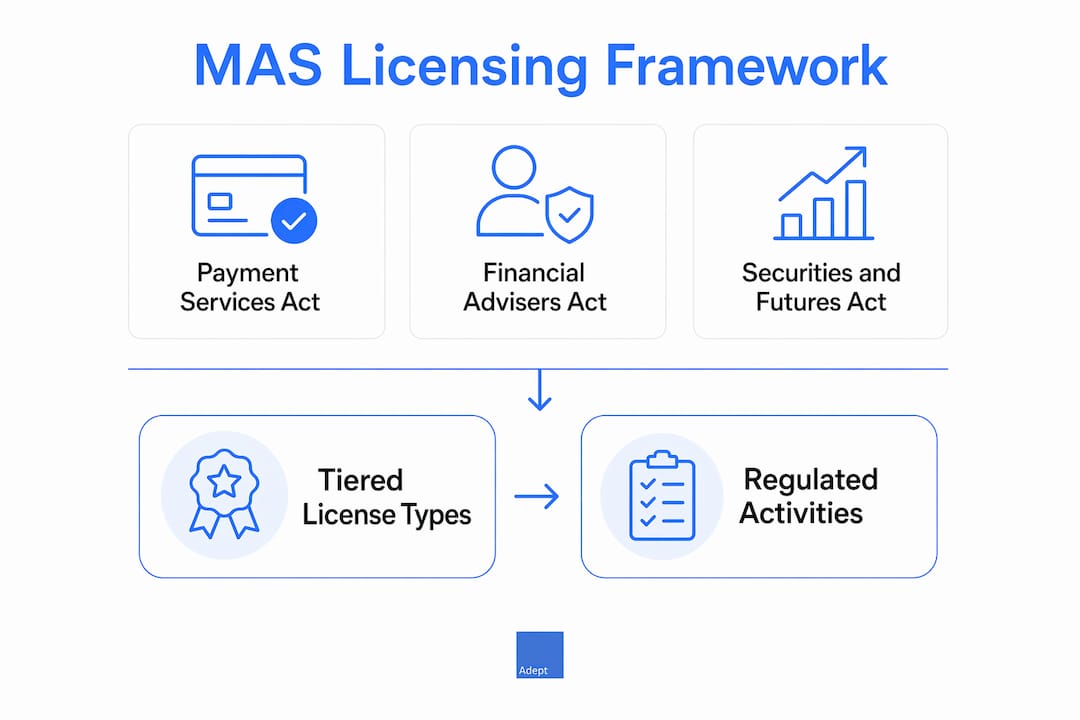
The Monetary Authority of Singapore (MAS) defines a regulated activity as any financial service requiring a license before a business may legally operate in Singapore. Understanding Singapore regulated activities MAS explained is not optional for financial services businesses. MAS functions as both Singapore's central bank and its integrated financial regulator, overseeing capital markets, payment services, insurance, and financial advisory activities under three primary legislative frameworks: the Securities and Futures Act (SFA), the Financial Advisers Act (FAA), and the Payment Services Act (PSA). Each framework defines specific regulated activities and the licenses required to conduct them. Operating without the correct license exposes a business to fines, license revocation, and public sanctions.
What are the main MAS legislative frameworks governing regulated activities?
MAS regulates financial activities under three distinct statutes, each targeting a different segment of the financial sector. Knowing which statute applies to your business is the first step in any licensing process.
The Securities and Futures Act (SFA)
The SFA governs capital markets activities in Singapore. It covers dealing in capital market products, fund management, providing custodial services, securities financing, and leveraged foreign exchange trading. Businesses conducting these activities must hold a Capital Markets Services (CMS) license issued by MAS. The Securities and Futures (Licensing and Conduct of Business) Regulations translate the SFA into practical rules covering documentation standards, risk disclosures, conduct requirements, and customer money handling. These regulations set the operational baseline every CMS licensee must meet from day one.

The Financial Advisers Act (FAA)
The FAA governs financial advisory services, including advising on investment products, marketing collective investment schemes, and arranging life insurance policies. Businesses providing these services must hold a Financial Adviser (FA) license. The FAA applies to a wide range of intermediaries, from independent financial advisers to corporate advisory firms. Businesses that provide corporate finance advisory services must carefully assess whether their activities fall under the FAA, the SFA, or both.
The Payment Services Act (PSA)
The PSA regulates payment service providers and digital token service businesses. It introduced a tiered licensing structure with three license classes: the Money-Changing License, the Standard Payment Institution (SPI) License, and the Major Payment Institution (MPI) License. The applicable license depends on the type and transaction volume of payment services offered. AML/CFT compliance under the PSA is governed by MAS Notice PSN01, which sets out specific customer due diligence and transaction monitoring requirements.
Pro Tip: If your business model spans activities under more than one statute, you may need multiple licenses. Map every revenue-generating activity against all three frameworks before submitting any application.
| Statute | License Type | Sample Regulated Activities |
|---|---|---|
| Securities and Futures Act (SFA) | Capital Markets Services (CMS) | Fund management, dealing in securities, custodial services |
| Financial Advisers Act (FAA) | Financial Adviser (FA) | Investment advice, marketing collective investment schemes |
| Payment Services Act (PSA) | SPI or MPI License | Digital payment tokens, cross-border money transfers |
What categories of financial activities does MAS regulate?
MAS regulated activity categories cover a broad spectrum of financial services. Businesses must identify which categories apply before registering or expanding operations in Singapore.
The main categories include:
- Dealing in capital market products: Buying or selling securities, futures contracts, or collective investment scheme units on behalf of clients.
- Fund management: Discretionary management of investment portfolios for third-party clients, including family offices and institutional investors.
- Custodial services: Safeguarding and administering client assets, including securities and cash.
- Corporate finance advisory: Advising on mergers, acquisitions, initial public offerings, and other capital-raising transactions.
- Financial advisory services: Recommending investment products or life insurance policies to retail or accredited investors.
- Payment services: Operating account issuance, domestic or cross-border money transfers, merchant acquisition, or digital token services.
- Insurance: Underwriting or broking life and general insurance products.
Each category maps directly to a specific license type under the SFA, FAA, or PSA. A business that manages client funds and also provides investment advice may need both a CMS license and an FA license.
How SSIC codes affect your licensing timeline
SSIC codes selected during company registration signal the nature of a business's activities to ACRA and trigger MAS licensing referrals or clearance processes. This is a step many new entrants underestimate. Incorrect SSIC classification can cause referral delays of 14 to 60 days as licensing agencies conduct additional background and compliance checks. Selecting the wrong code at registration does not just slow things down. It can require a formal amendment process and restart portions of the licensing review. Businesses should confirm their SSIC codes with a qualified advisor before filing with ACRA.
Pro Tip: Review the full SSIC code list against your planned business activities, not just your company name. A fintech firm processing payments and managing assets needs codes that reflect both functions.
What ongoing compliance requirements must MAS-regulated businesses maintain?
Obtaining a license is not the end of the compliance process. MAS expects a culture of compliance integrated into daily operations, not just adherence at the licensing stage. Governance and AML/CFT programs must be maintained throughout a business's life.
The core ongoing obligations include:
- AML/CFT compliance programs: Written policies covering customer due diligence, transaction monitoring, suspicious transaction reporting, and record-keeping. Specific requirements are set out in MAS Notices PSN01, SFA 04-N02, and Notice 626, depending on the license type.
- Compliance function: A designated compliance officer or team with sufficient authority to enforce internal policies. This role can be outsourced, but accountability must remain with the licensee at all times.
- Governance and internal controls: Documented policies on conflicts of interest, risk management, and business continuity. MAS expects these to be reviewed and updated regularly.
- Reporting and notification duties: Timely submission of annual returns, material change notifications, and suspicious transaction reports to MAS.
- Conduct standards: Fair dealing with clients, proper disclosure of fees and risks, and adherence to the Securities and Futures (Licensing and Conduct of Business) Regulations.
One nuance that catches new licensees off guard involves the compliance function. A designated compliance function with real authority is mandatory for all MAS licensees. Outsourcing is permitted, but the arrangement must be documented and the licensee retains full accountability. Delegating compliance to a third party without retaining oversight is a breach of MAS expectations, not a solution to them.
Pro Tip: Schedule a formal compliance review at least quarterly. MAS inspections can occur without advance notice, and documented evidence of regular internal reviews significantly reduces regulatory risk.
The compliance officer role carries specific expectations under MAS regulations. The officer must have direct access to senior management and the authority to escalate concerns without interference. Businesses that treat compliance as a back-office function rather than a governance priority consistently face the most difficulty during MAS inspections.
What are the penalties for non-compliance with MAS requirements?
Non-compliance with MAS licensing or AML/CFT requirements carries serious financial and reputational consequences. MAS enforces its rules consistently and publicly.
The main enforcement actions include:
- Financial penalties: Fines of up to S$1 million per offence, plus S$100,000 per day for continuing offences. These figures apply to both corporate entities and individual officers.
- License revocation or restriction: MAS can restrict business activities or revoke licenses for serious or repeated breaches. A revoked license cannot simply be reapplied for without addressing the underlying failures.
- Public reprimands: MAS publishes enforcement actions on its website. A public reprimand damages client trust and business relationships in ways that outlast the original penalty.
- Sanctions on individuals: Directors and senior managers can be personally sanctioned, disqualified, or held liable for compliance failures within their area of responsibility.
"MAS's enforcement record shows that financial penalties are only one tool in its arsenal. License revocation and individual sanctions are used when systemic failures or deliberate non-compliance are identified."
AML/CFT compliance is the most frequently enforced regulatory area across MAS-licensed sectors. Businesses that treat AML/CFT as a documentation exercise rather than an operational control consistently attract the most severe enforcement outcomes. The 7 MAS license routes each carry their own specific compliance thresholds, and enforcement actions are calibrated to the license type and the severity of the breach.
How can businesses approach MAS licensing and compliance practically?
A structured approach to licensing and compliance reduces delays and avoids the most common regulatory pitfalls. The steps below apply to businesses entering Singapore's regulated financial sector for the first time.
- Map your activities against all three frameworks. Identify every revenue-generating activity and match it to the SFA, FAA, or PSA. Do this before registering your company.
- Select the correct SSIC codes. Work with a qualified advisor to confirm that your SSIC codes accurately reflect your planned activities. Errors here create delays of 14 to 60 days and may require formal amendments.
- Prepare your license application thoroughly. MAS applications require detailed business plans, financial projections, fit-and-proper assessments for key personnel, and draft compliance policies. Incomplete applications are returned, not processed.
- Establish your compliance function before launch. Appoint a compliance officer with documented authority and direct reporting lines to senior management. If outsourcing, execute a formal service agreement that retains accountability internally.
- Build your AML/CFT program from the relevant MAS Notice. Use PSN01, SFA 04-N02, or Notice 626 as your baseline, depending on your license type. Generic AML policies not tailored to your license type will not satisfy MAS.
- Maintain audit readiness at all times. Keep records of compliance reviews, training logs, transaction monitoring outputs, and policy updates. MAS inspections do not always come with advance notice.
Businesses with complex structures or multi-jurisdictional operations benefit from engaging qualified consultants early. The regulatory compliance services required for MAS-licensed businesses go well beyond standard corporate governance. Early engagement with experienced advisors reduces application preparation time and avoids costly rework.
Pro Tip: Engage MAS proactively if your business model is novel or spans multiple regulated activity categories. MAS offers pre-licensing consultations, and early dialogue often clarifies requirements that would otherwise cause application delays.
Key Takeaways
Singapore's MAS regulatory framework requires businesses to obtain the correct license under the SFA, FAA, or PSA before conducting any regulated financial activity, and to maintain ongoing compliance programs throughout the life of the license.
| Point | Details |
|---|---|
| Three governing statutes | The SFA, FAA, and PSA each define specific regulated activities and the licenses required to conduct them. |
| SSIC code accuracy matters | Incorrect classification at registration delays licensing approvals by 14 to 60 days. |
| Compliance is continuous | AML/CFT programs, governance frameworks, and reporting duties apply throughout the license period, not just at application. |
| Penalties are severe | Non-compliance can result in fines up to S$1 million per offence, license revocation, and individual sanctions. |
| Compliance function accountability | Outsourcing the compliance function is permitted, but the licensee retains full accountability under MAS rules. |
What we have learned from guiding businesses through MAS compliance
The most consistent mistake we see is treating MAS compliance as a one-time setup task. Businesses invest heavily in their license application, then allow their compliance programs to drift once operations begin. MAS does not view compliance that way. Its inspection framework is designed to assess whether governance and AML/CFT controls are embedded in daily operations, not just documented in a policy binder.
The second most common oversight is underestimating the SSIC code selection. We have seen businesses delay their entire market entry by weeks because their registered activity codes did not align with their actual business model. ACRA's referral process to MAS is automatic and non-negotiable once a financial services code is selected. Getting this right at the start is far less costly than correcting it after registration.
The compliance function question also generates more confusion than it should. Outsourcing is a legitimate and practical option for smaller licensees, but the arrangement must be documented with precision. The licensee cannot transfer accountability. We have reviewed outsourced compliance arrangements that would not survive a basic MAS review because the service agreement was too vague about escalation procedures and reporting lines.
Our strongest advice is to engage MAS early and engage experienced advisors before you file anything. The regulatory framework in Singapore is well-designed and navigable. The businesses that struggle are almost always those that attempt to self-manage a complex licensing process without adequate preparation or professional support.
— Wandy & Terence
How Adept Corporate Services supports MAS licensing and compliance
Adept Corporate Services works with businesses at every stage of the MAS licensing process, from initial activity mapping and SSIC code selection through to license application preparation and ongoing compliance management.
Whether you are applying for a Capital Markets Services license, a Financial Adviser license, or a Payment Institution license, Adept Corporate Services provides expert guidance on application requirements, AML/CFT program design, and governance framework setup. The team also supports businesses with company registration in Singapore and SSIC code classification to avoid licensing delays from the outset. For businesses already licensed, Adept Corporate Services offers MAS compliance outsourcing with full accountability retained by the licensee as required by MAS. Contact Adept Corporate Services directly to speak with a specialist.
FAQ
What is a regulated activity under MAS?
A regulated activity is any financial service, such as fund management, dealing in securities, or providing payment services, that requires a MAS license before a business may legally operate in Singapore.
Which law governs fund management in Singapore?
Fund management is regulated under the Securities and Futures Act (SFA). Businesses managing third-party investment portfolios must hold a Capital Markets Services (CMS) license issued by MAS.
What happens if a business operates without an MAS license?
Operating a regulated financial activity without the required MAS license can result in fines of up to S$1 million per offence, plus S$100,000 per day for continuing breaches, as well as potential criminal prosecution.
Can a business outsource its MAS compliance function?
Yes. MAS permits outsourcing of the compliance function, but the licensee must retain full accountability, document the arrangement formally, and ensure the compliance officer has direct access to senior management.
How do SSIC codes affect MAS licensing?
SSIC codes selected at company registration trigger automatic referrals to MAS for licensing checks. Incorrect codes can delay approvals by 14 to 60 days and may require formal amendments before the licensing process can proceed.