
A compliance officer in Singapore is a designated control function responsible for overseeing an organization's adherence to regulatory obligations, managing compliance risk, and reporting governance failures directly to senior management and the board. The Singapore compliance officer role explained in full covers far more than policy writing. Under frameworks like the Monetary Authority of Singapore's (MAS) Securities and Futures Act (SFA) and the Payment Services Act (PSA), the role carries board-level accountability and operates as a formal governance mechanism. Whether you are an HR manager building a compliance team or a business leader assessing your regulatory exposure, understanding what this role actually requires is the first step toward getting it right.
What are the key responsibilities of a compliance officer in Singapore?
The compliance officer's core function is to identify, assess, and manage the regulatory risks that a business faces across its operations. This is not an administrative support role. Under MAS Notice SFA 04-N02, compliance is positioned as a governance control function with the authority to alert senior management when regulatory obligations are at risk of being breached.
In practice, the daily work of a compliance officer in a Singapore multinational covers several distinct operational areas:
- Client onboarding and KYC/CDD reviews: Compliance officers review new client files against Know Your Customer (KYC) and Customer Due Diligence (CDD) standards, checking for politically exposed persons, sanctions hits, and adverse media.
- Transaction monitoring and suspicious activity: Officers monitor flagged transactions, investigate anomalies, and file Suspicious Transaction Reports (STRs) with the Suspicious Transaction Reporting Office (STRO) where required.
- AML/CFT policy advisory: Compliance officers advise business units on Anti-Money Laundering and Countering the Financing of Terrorism (AML/CFT) obligations, translating regulatory requirements into operational procedures.
- Risk indicator monitoring: Officers track compliance risk indicators across business lines and report trends to governance committees.
- Board and senior management reporting: Compliance reporting to boards must be decision-ready, meaning it highlights issues, assesses impact, recommends remediation, and triggers escalation when needed.
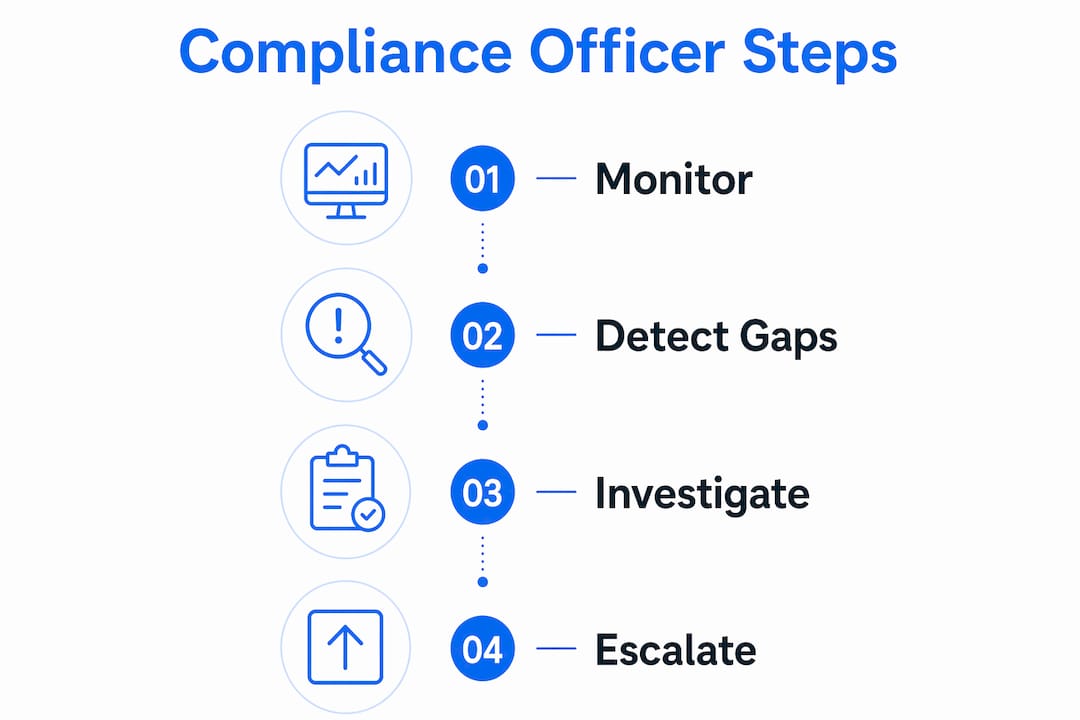
The operational workflow typically follows a sequential control process: monitor, detect gaps, investigate, and escalate. This monitor-to-escalate workflow is a standard feature of financial crime compliance roles and reflects how regulators expect compliance functions to operate in real time, not retrospectively.
Pro Tip: When building a compliance reporting template for board use, structure it around four columns: issue identified, regulatory obligation at risk, recommended action, and deadline. This format forces decision-ready outputs rather than informational summaries.
Typical Singapore compliance job descriptions indicate a preference for three to five years of experience, with core knowledge in AML/CFT and due diligence processes. This experience threshold reflects the depth of judgment the role demands, particularly when escalation decisions carry regulatory consequences.
How does the compliance officer role differ across industries and from the company secretary?
The compliance officer role is not uniform across sectors, and conflating it with the company secretary function is one of the most common and costly mistakes organizations make in Singapore.
Financial services vs. other regulated sectors
In financial services, the compliance officer's primary focus is MAS regulatory compliance, AML/CFT program management, and licensing conditions under the PSA, SFA, or Financial Advisers Act (FAA). The role is explicitly required to have sufficient authority and expertise over AML/CFT obligations. MAS-regulated payment service providers must maintain this function internally or through a documented outsourcing arrangement, but accountability cannot be delegated to a third party.

In sectors like pharmaceuticals and manufacturing, the compliance officer's scope shifts entirely. At companies like Takeda Pharmaceutical, quality compliance specialists manage audit programs, quality-system governance, regulatory inspections, and product recall reporting. The applicable frameworks are Eudralex and 21 CFR rather than MAS notices. The skills required overlap in areas like documentation and investigation, but the regulatory perimeter is completely different.
Compliance officer vs. company secretary: a critical distinction
| Function | Compliance officer | Company secretary |
|---|---|---|
| Legal basis | Sector-specific regulation (MAS, HSA, etc.) | Companies Act (ACRA requirement) |
| Core duties | Regulatory risk management, AML/CFT, investigations | Statutory filings, governance records, AGM support |
| Reporting line | Senior management and board (governance control) | Board of directors (administrative support) |
| Appointment trigger | Regulatory license or sectoral obligation | Required within 6 months of incorporation |
| Accountability scope | Operational compliance across business lines | Statutory registers and filing deadlines |
Under the Companies Act, every Singapore company must appoint a company secretary within six months of incorporation. The secretary maintains statutory registers, manages ACRA filings, and supports inspection readiness. This role does not replace sectoral compliance obligations. Misattributing compliance responsibilities to the company secretary can expose organizations to serious regulatory gaps, particularly under MAS and other licensing regimes.
Pro Tip: When onboarding a new entity in Singapore, map your regulated perimeter first. If you hold a MAS license, a company secretary alone is not sufficient. You need a separate compliance function with documented authority and reporting lines.
HR professionals in multinationals frequently assign compliance tasks to whoever handles governance paperwork. This creates a structural gap that regulators will identify during inspections. The governance roles of directors, company secretaries, and compliance officers each occupy distinct positions in Singapore's regulatory framework and should not be merged for convenience.
What are the regulatory expectations and enforcement risks for compliance officers?
MAS sets explicit expectations for how compliance functions must be structured, resourced, and empowered within regulated entities. These are not aspirational guidelines. They are enforceable conditions tied to licensing.
MAS requires compliance functions to have sufficient authority, independence, and expertise to fulfill their obligations. This means the compliance officer must have direct access to senior management and the board, the ability to escalate without obstruction, and the resources to conduct investigations. A compliance officer who reports only to the CFO or sits within a business unit lacks the structural independence MAS expects.
The enforcement consequences for compliance failures are significant:
- Fines of up to S$1 million per offence for serious breaches under MAS regimes. This figure signals that regulators treat compliance failures as material risks, not administrative oversights.
- Licence revocation for repeated or egregious breaches, which effectively ends a regulated business's ability to operate in Singapore.
- Remediation requirements that can include external audits, enhanced monitoring, and mandatory reporting to MAS for defined periods.
"Outsourcing compliance functions does not remove the license-holder's accountability. Arrangements must be documented and disclosed to MAS where required. The regulated entity remains fully responsible for the quality and completeness of its compliance program."
This point matters enormously for multinationals that rely on regional compliance teams or outsourced providers. Outsourcing compliance oversight is permitted under MAS frameworks, but the Singapore entity must retain documented control and cannot transfer regulatory accountability to a vendor. Adept-cs works with clients on exactly this structure, ensuring outsourced arrangements meet MAS disclosure and documentation standards. You can review the applicable regulatory compliance framework for Singapore-licensed entities.
What qualifications and experience does a Singapore compliance officer need?
Hiring managers and HR professionals in multinationals frequently underestimate the qualification bar for this role. A compliance officer in Singapore is not an entry-level hire, and the combination of technical knowledge, regulatory familiarity, and interpersonal judgment required is specific.
Educational background: Most compliance officers hold degrees in business, law, finance, accounting, or a related discipline. In financial services, a law or finance degree is common. In pharmaceuticals, a science or engineering background is often preferred.
Professional certifications: The Certified Anti-Money Laundering Specialist (CAMS) designation, awarded by ACAMS, is the most recognized credential for AML/CFT compliance roles in Singapore. Data protection officers may also hold the International Association of Privacy Professionals (IAPP) Certified Information Privacy Professional (CIPP) designation. For capital markets roles, the MAS-recognized Representative Notification Framework (RNF) may apply.
Experience range: Most Singapore compliance job descriptions specify three to seven years of relevant experience, depending on the seniority of the role and the complexity of the regulatory environment. Senior compliance officers at MAS-licensed entities often have ten or more years of sector-specific experience.
Sector-specific knowledge: In financial services, deep familiarity with AML/CFT frameworks, MAS notices, and FATF recommendations is non-negotiable. In pharmaceuticals, knowledge of Good Manufacturing Practice (GMP) standards and regulatory inspection processes is required. HR teams must define the regulated perimeter before writing a job description.
Soft skills that matter: The compliance officer must communicate regulatory obligations clearly to non-specialist business units, maintain independence under commercial pressure, and conduct investigations with discretion. These are not generic competencies. They are specific to the governance control function the role occupies.
Key takeaways
A compliance officer in Singapore is a board-accountable governance control function, not an administrative role, and its scope, authority, and qualifications must match the regulated perimeter of the business.
| Point | Details |
|---|---|
| Governance control function | MAS positions compliance as a board-level role with escalation authority, not an administrative support function. |
| Sector-specific scope | Financial services, pharmaceuticals, and corporate governance each require distinct compliance expertise and regulatory knowledge. |
| Company secretary distinction | The company secretary fulfills statutory ACRA obligations; the compliance officer manages operational regulatory risk. These roles must not be merged. |
| Outsourcing accountability | Outsourcing compliance functions is permitted under MAS, but the licensed entity retains full regulatory accountability. |
| Qualification threshold | Most Singapore compliance roles require three to seven years of experience plus sector-specific certifications such as CAMS or CIPP. |
Why the compliance officer role is more consequential than most organizations realize
Most organizations I work with treat the compliance officer appointment as a box-ticking exercise. They hire someone with a general finance background, give them a policy manual, and assume the function is covered. That approach fails consistently, and it fails in ways that are expensive to fix.
The structural independence requirement is the piece that gets ignored most often. A compliance officer who reports to the CFO, shares a budget line with the business unit they monitor, or lacks direct board access cannot perform the governance control function MAS expects. The reporting line is not a formality. It determines whether the officer can escalate a serious breach without commercial interference.
The confusion between company secretary and compliance officer functions is equally persistent. I have seen multinationals assign AML/CFT monitoring responsibilities to their corporate secretary because the secretary "handles compliance paperwork." These are fundamentally different roles. The statutory compliance calendar for a Singapore company is the company secretary's domain. The regulatory risk program is the compliance officer's domain. Mixing them creates gaps that neither role is equipped to fill.
On outsourcing: the MAS position is clear, and it is frequently misunderstood. Outsourcing the compliance function to a regional team or a third-party provider does not transfer accountability. The Singapore entity must document the arrangement, retain oversight, and be able to demonstrate to MAS that the function is operating effectively. I have seen firms discover this only during an MAS inspection, which is the worst possible time to learn it.
The future direction is toward greater regulatory scrutiny, not less. MAS has consistently expanded its supervisory perimeter, and digital asset regulation under the PSA has added new compliance obligations for a growing number of entities. Organizations that invest in properly structured, well-resourced compliance functions now will be significantly better positioned than those that treat it as a cost to minimize.
— Terence
How Adept-cs supports compliance functions in Singapore
Adept-cs provides corporate secretarial and regulatory compliance services to companies, funds, and trusts operating in Singapore. For multinationals building or reviewing their compliance structure, Adept-cs offers practical support across statutory appointments, MAS licensing conditions, and ongoing governance filings. Whether you need a properly documented outsourcing arrangement for your compliance function or a company secretary appointment that meets ACRA requirements, the team at Adept-cs delivers directly. No automated responses, no handoffs to junior staff. Explore Adept-cs's corporate secretarial services or review the full range of corporate services in Singapore to find the right structure for your entity.
FAQ
What is a compliance officer in Singapore?
A compliance officer in Singapore is a designated governance control function responsible for managing regulatory risk, implementing AML/CFT programs, and reporting compliance failures to senior management and the board. Under MAS frameworks, the role carries board-level accountability and must operate with sufficient independence and authority.
How is a compliance officer different from a company secretary?
A company secretary fulfills statutory obligations under the Companies Act, including ACRA filings and governance records. A compliance officer manages operational regulatory risk under sector-specific regimes such as MAS, HSA, or other licensing frameworks. The two roles are legally and functionally distinct and should not be combined.
Can a Singapore company outsource its compliance function?
Yes, MAS permits outsourcing of compliance functions, but the licensed entity retains full regulatory accountability. The outsourcing arrangement must be documented and disclosed to MAS where required, and the entity must demonstrate ongoing oversight of the outsourced function.
What certifications are most valued for compliance officers in Singapore?
The CAMS (Certified Anti-Money Laundering Specialist) designation from ACAMS is the most recognized credential for financial services compliance roles. Data protection officers often hold the IAPP CIPP certification. Sector-specific knowledge of MAS notices, FATF recommendations, or GMP standards is equally important depending on the industry.
What are the penalties for compliance failures under MAS?
Serious compliance failures under MAS regimes can result in fines of up to S$1 million per offence and licence revocation for repeated breaches. These penalties apply to the regulated entity, reinforcing why the compliance officer function must be properly resourced and structurally independent.
Recommended
- Regulatory Compliance Services Singapore | Adept Corporate Services
- New Register of Registrable Controllers (RORC) Filing Requirements from 16 June 2025 | Adept Corporate Services
- Directors' Duties & Responsibilities in Singapore | Adept Corporate Services
- Expert Tax Compliance Services for Singapore Businesses | Adept Corporate Services