
Singapore digital asset firm licensing is the formal process of obtaining regulatory approval from the Monetary Authority of Singapore (MAS) to legally operate digital payment token or capital markets services within the city-state. Without this approval, no firm may legally offer digital asset services to customers in Singapore. MAS enforces this requirement under the Payment Services Act (PSA) and the Financial Services and Markets Act (FSMA), two frameworks that together govern the full spectrum of digital asset activities. For entrepreneurs entering this market, understanding which license applies, what it costs, and how to apply without delay is the difference between a smooth launch and a costly regulatory setback.
What is Singapore digital asset firm licensing and which law governs it?
Singapore digital asset firm licensing sits under two primary statutes: the Payment Services Act and the Financial Services and Markets Act. The PSA governs payment-related digital token services, while the FSMA covers digital token service providers (DTSPs) operating outside the PSA's scope, such as firms facilitating cross-border digital asset transactions or providing custody services. MAS administers both frameworks and holds the authority to grant, suspend, or revoke licenses. Firms that handle digital payment tokens, whether through exchange, transfer, or custody, must hold a valid MAS license before accepting a single customer transaction.
The regulatory perimeter is deliberately broad. MAS defines "digital payment tokens" to include cryptocurrencies such as Bitcoin and Ether, meaning that any Singapore-incorporated entity or foreign firm with a local presence that buys, sells, or facilitates the exchange of these assets requires a license. This scope also captures firms providing over-the-counter trading desks, digital asset custody, and initial exchange offerings. Entrepreneurs should assess their full service offering against MAS definitions before assuming an exemption applies.

What types of digital asset licenses are available in Singapore?
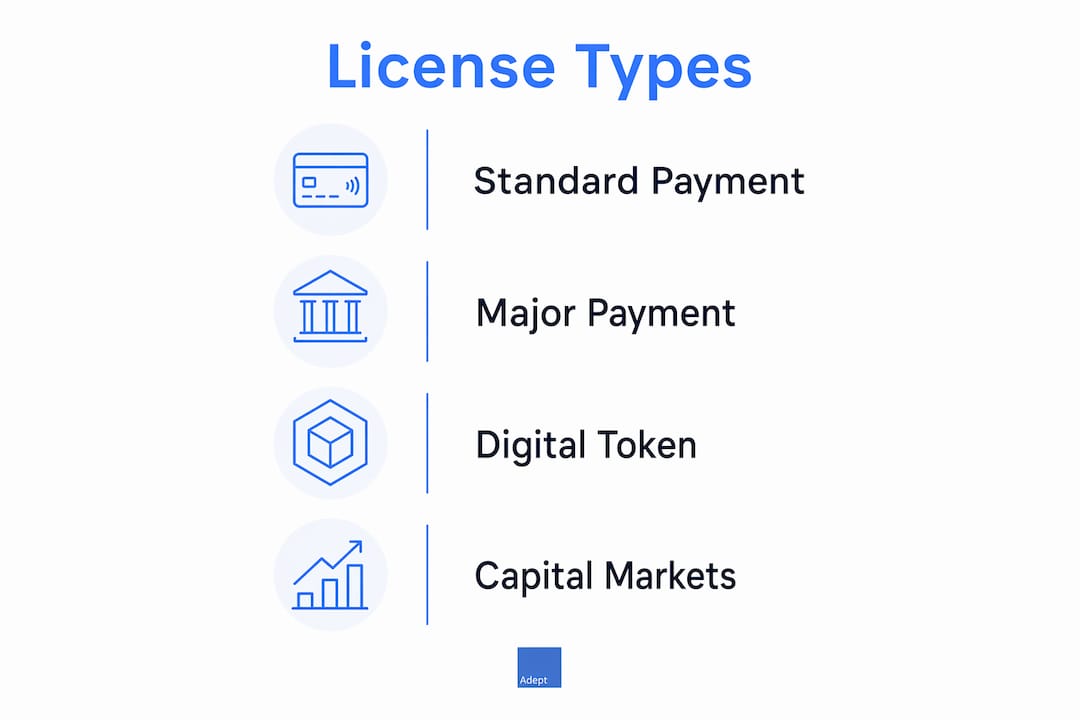
MAS issues four primary license types relevant to digital asset firms. Each applies to a different business model and carries distinct capital, compliance, and operational requirements.
| License Type | Key Activity | Min. Capital | Annual Fee |
|---|---|---|---|
| Standard Payment Institution (SPI) | Digital payment token services below S$3M/month | S$100,000 | Prorated on grant |
| Major Payment Institution (MPI) | Digital payment token services above S$3M/month | S$250,000 | ~S$10,000 |
| Digital Token Service Provider (DTSP) | Cross-border DPT services under FSMA | S$250,000 | S$1,500 application fee |
| Capital Markets Services (CMS) | Fund management, dealing in securities or derivatives | S$250,000–S$5,000,000 | Varies by activity |
The SPI and MPI thresholds are defined by monthly transaction volume. Firms processing below S$3 million per month qualify for the SPI, while those exceeding that volume must hold an MPI. This distinction matters because the MPI carries higher security deposit obligations. Security deposits escalate from S$100,000 to S$200,000 as payment volumes exceed S$6 million per month.
The CMS license applies to firms managing digital asset funds, dealing in digital securities, or providing leveraged digital asset trading. Capital requirements under the CMS license range from S$250,000 to S$5,000,000 depending on the regulated activity. Firms offering multiple services, such as both payment token exchange and fund management, may need to hold more than one license simultaneously.
The DTSP license under the FSMA is the newest category and targets firms that primarily serve non-Singapore customers from a Singapore base. DTSP applicants must comply with minimum capital of S$250,000 and pay an application fee of S$1,500, with annual fees prorated from the grant date.
What are the capital, staffing, and compliance requirements?
Meeting MAS prerequisites before filing is non-negotiable. Submitting an incomplete or underprepared application wastes months and risks rejection.
Capital requirements by license type
- SPI: Minimum base capital of S$100,000, plus a S$100,000 security deposit for digital payment token services.
- MPI: Minimum base capital of S$250,000, with security deposits rising to S$200,000 for firms exceeding S$6 million in monthly transaction volume.
- DTSP: Minimum capital of S$250,000 under the FSMA framework.
- CMS: Capital ranges from S$250,000 to S$5,000,000 based on the specific regulated activity.
Understanding the difference between issued and paid-up capital is critical here. MAS requires that capital be fully paid up and available, not merely authorized on paper.
Staffing and governance prerequisites
MAS sets firm staffing minimums for all license types. The CMS license requires at least two directors, one of whom must be a Singapore resident, plus two full-time locally based staff per regulated activity. SPI and MPI applicants must appoint a Singapore-resident director and at least one Key Appointed Individual (KAI) who meets MAS's fit-and-proper criteria. The KAI must demonstrate relevant industry experience and pass MAS's personal declaration and background checks.
AML/CFT compliance framework
MAS expects every applicant to have a documented Anti-Money Laundering and Countering the Financing of Terrorism (AML/CFT) framework in place before submission. This includes written policies, transaction monitoring procedures, customer due diligence protocols, and a designated compliance officer. Firms without a functioning AML/CFT program at the time of application face near-certain rejection.
Physical presence and audit obligations
MAS requires applicants to maintain a physical office in Singapore, not merely a registered address. Post-license, firms must submit annual audited financial statements and periodic MAS regulatory returns. Independent auditor reports on AML/CFT controls are required both at application and on an ongoing basis.
Pro Tip: Start building your AML/CFT framework at least six months before you plan to file. MAS reviewers scrutinize the maturity and operational depth of compliance programs, not just whether a policy document exists.
How does the MAS digital asset license application process work?
The MAS application process follows a defined sequence. Deviating from it or submitting incomplete documentation extends review timelines significantly.
- Incorporate your Singapore entity. MAS only licenses Singapore-incorporated companies. Complete company registration before filing any license application.
- Appoint qualified personnel. Confirm your Singapore-resident director and KAI are in place and have passed internal fit-and-proper assessments.
- Build your compliance framework. Finalize AML/CFT policies, appoint a compliance officer, and document your transaction monitoring system.
- Obtain a legal opinion. MAS requires an independent legal opinion confirming that your business activities fall within the scope of the license you are applying for.
- Commission an independent AML/CFT audit. An external auditor must assess and certify your AML/CFT controls before submission.
- Complete and file Form 1 with MAS. Form 1 is the primary application document. Attach all supporting materials, including corporate structure charts, business plans, financial projections, and personnel declarations.
- Pay the application fee. Fees are S$1,000 for SPI and S$1,500 for MPI and DTSP applications.
- Respond to MAS queries. MAS typically issues clarification requests during review. Respond promptly and completely to avoid delays.
- Await approval. MAS review periods average 6–9 months from the date of a complete submission. Incomplete filings restart the clock.
- Receive license and commence operations. Do not begin regulated activities before the license is formally granted.
CEO and director approvals require separate MAS personal declarations and may involve interviews. Budget time for this step, as personnel assessments run concurrently with the main application review but can independently delay approval if documentation is deficient.
Pro Tip: Engaging a professional advisory firm with direct MAS licensing experience, such as Adept Corporate Services, reduces submission errors and accelerates the back-and-forth query cycle that most applicants underestimate.
What are the most common mistakes in Singapore crypto firm registration?
Most rejections stem from immature AML/CFT frameworks and inadequately vetted senior personnel, not from flawed business models. Knowing where applications fail helps you avoid the same outcome.
- Weak AML/CFT controls. Applicants submit policy documents without evidence of operational implementation. MAS expects live systems, not draft templates.
- Unqualified key personnel. KAIs without documented industry experience or with undisclosed adverse history fail fit-and-proper assessments. Conduct thorough internal due diligence before nominating anyone.
- Operating before license grant. Operating without a license or exemption exposes firms to MAS enforcement action, including fines and criminal prosecution. No "soft launch" is permissible for regulated activities.
- Missing mandatory documents. Omitting the independent legal opinion or the auditor's AML/CFT certification causes immediate rejection. These are not optional attachments.
- Insufficient capital at filing. MAS verifies that required capital is fully paid up at the time of application. Firms that plan to raise capital after filing do not meet this requirement.
Maintaining compliance after license grant is equally demanding. MAS conducts ongoing supervision, including thematic inspections and ad hoc audits. Firms must update their AML/CFT frameworks as MAS issues new guidelines and report material changes to their business model or key personnel without delay. Engaging a regulatory compliance specialist on a retainer basis is the most reliable way to stay current with MAS expectations post-licensing.
Key Takeaways
Singapore digital asset firm licensing requires the right license type, fully paid-up capital, qualified resident personnel, and a mature AML/CFT framework before MAS will approve any application.
| Point | Details |
|---|---|
| Choose the correct license | SPI, MPI, DTSP, or CMS each apply to distinct business models and transaction volumes. |
| Meet capital thresholds upfront | Capital must be fully paid up at filing: S$100,000 for SPI, S$250,000 for MPI and DTSP. |
| Staff your firm correctly | Appoint a Singapore-resident director and a qualified Key Appointed Individual before submitting. |
| Build AML/CFT before filing | MAS rejects applications with immature or undocumented compliance frameworks. |
| Plan for a 6–9 month review | Budget time and resources for the full MAS review cycle and query response process. |
Why MAS licensing is more than a compliance checkbox
From our experience working with digital asset firms across Singapore, the MAS licensing process is frequently underestimated as a bureaucratic hurdle. That framing is a mistake. The process forces a level of governance discipline that most early-stage firms would not otherwise impose on themselves, and that discipline pays dividends well beyond the license grant date.
Firms that have gone through the full MAS process emerge with documented compliance frameworks, vetted leadership teams, and audited financial controls. Institutional investors and banking partners treat a MAS license as a credibility signal. Industry observers, including Ng of CSOP Asset Management, describe the MAS license as the gold standard for fintech credibility in Asia. That reputation is not accidental. MAS has deliberately set a high bar, and firms that clear it gain a competitive advantage that is difficult to replicate through marketing alone.
The entrepreneurs who succeed in this process share one trait: they treat licensing preparation as a business-building exercise, not a paperwork exercise. They hire compliance officers early, engage legal counsel before filing, and stress-test their AML/CFT systems before MAS ever reviews them. The firms that struggle treat the application as a form-filling task and discover too late that MAS is evaluating the entire operational readiness of their business.
Our recommendation is straightforward. Engage with MAS guidelines and a qualified advisory firm at least 12 months before your target launch date. Use that time to build the compliance infrastructure that MAS expects to see, not to rush a submission that will generate months of clarification queries.
— Wandy & Terence
How Adept Corporate Services supports your MAS licensing process
Adept Corporate Services works directly with digital asset firms at every stage of the MAS licensing process, from initial license selection through application submission and post-license compliance management.
The team at Adept Corporate Services has hands-on experience with MAS license routes across the SPI, MPI, DTSP, and CMS categories. Adept handles corporate structuring, capital verification, KAI assessments, AML/CFT framework development, and Form 1 preparation. For firms starting from scratch, Adept's company setup and treasury services cover Singapore incorporation, registered office, and the full compliance infrastructure needed to support a license application. Every client works directly with a qualified advisor, with no automated responses or outsourced queues. Contact Adept Corporate Services to discuss your licensing requirements and timeline.
FAQ
What is the minimum capital for a Singapore digital payment token license?
The SPI requires S$100,000 in base capital, while the MPI and DTSP each require S$250,000. Capital must be fully paid up at the time of application.
How long does MAS take to approve a digital asset license application?
MAS review periods average 6–9 months from the date of a complete submission. Incomplete applications or slow responses to MAS queries extend this timeline.
Can a foreign company apply for a Singapore digital asset license?
A foreign company must first incorporate a Singapore-registered entity before applying. MAS licenses Singapore-incorporated companies only, and the entity must maintain a physical office in Singapore.
What is the difference between an SPI and an MPI license?
The SPI applies to firms with monthly digital payment token transaction volumes below S$3 million. The MPI applies to firms above that threshold and carries higher capital and security deposit requirements.
What causes most MAS digital asset license rejections?
Most rejections result from immature AML/CFT compliance frameworks and inadequately vetted key personnel, not from problems with the underlying business model.
Recommended
- Singapore Single Family Office 2026 Guide | Adept Corporate Services
- Starting and Setting Up a Business or Company in Singapore | Adept Corporate Services
- Corporate Finance Advisory Licensing in Singapore | Adept Corporate Services
- 2026 Statutory Compliance Calendar for a Singapore Company | Adept Corporate Services