
A Singapore joint venture is defined as a formal business arrangement where two or more parties combine resources, expertise, or capital to pursue a shared commercial objective. This singapore joint venture structuring guide covers the two primary legal forms available: an equity joint venture, structured as an incorporated private limited company, and a contractual joint venture, governed by a written agreement under contract law. Choosing the wrong structure creates liability exposure, tax complications, and governance disputes that are difficult to unwind. Executives and entrepreneurs who understand both options before signing anything protect their investment from the outset.
What are the key types of joint venture structures in Singapore?
Singapore JV structures fall into two distinct categories, and the choice between them shapes every downstream decision from liability to tax treatment. Equity JVs and contractual JVs each carry distinct legal and operational advantages that depend on the nature and duration of the collaboration.
Equity joint ventures
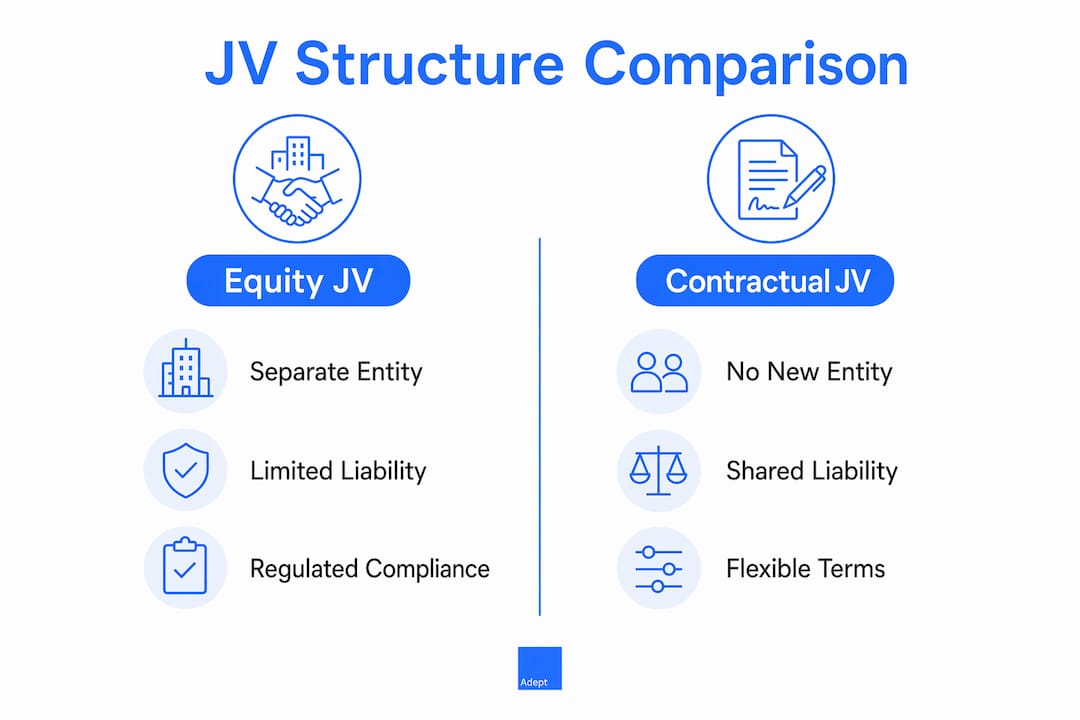
An equity joint venture is incorporated as a private limited company under Singapore's Companies Act. The JV entity is a separate legal person, which means each party's liability is limited to its capital contribution. This structure suits long-term projects, capital-intensive ventures, and situations where the parties need a clear corporate identity for contracting, banking, and regulatory purposes. The governance framework, including board composition and shareholder rights, is documented in both the company's constitution and the JV agreement.

Contractual joint ventures
A contractual joint venture does not create a new corporate entity. The parties operate under a written agreement governed by contract law and, where applicable, the Partnership Act 1890. This structure provides flexibility for short-term projects or collaborations where establishing a company would be disproportionate to the scope of work. The critical drawback is unlimited liability exposure. If the JV incurs debts or legal claims, each party's personal and business assets may be at risk.
Equity vs. contractual JV: a direct comparison
| Factor | Equity JV | Contractual JV |
|---|---|---|
| Legal entity | Separate private limited company | No new entity created |
| Liability | Limited to capital contribution | Potentially unlimited |
| Governance | Companies Act, constitution, JV agreement | Contract law, JV agreement only |
| Compliance burden | Higher (ACRA, IRAS, annual returns) | Lower |
| Best suited for | Long-term, capital-intensive projects | Short-term, project-specific work |
| Tax treatment | Corporate income tax applies to the entity | Income attributed to individual parties |
Pro Tip: If your JV involves third-party financing or regulatory licensing in Singapore, an equity structure is almost always required. Banks and regulators deal with legal entities, not contractual arrangements.
What must a joint venture agreement include?
A JV agreement is a critical risk management tool that determines dispute outcomes and governance clarity. A poorly drafted agreement is the single most common cause of JV failure, and courts interpret ambiguous clauses against the party that drafted them.
Every well-constructed JV agreement must address the following:
- Purpose and scope. Define the specific commercial objective and geographic scope. Vague purpose clauses invite scope creep and disagreements over what the JV is authorized to do.
- Capital contributions. State each party's financial commitment, the timing of contributions, and the consequences of a party failing to contribute on schedule.
- Governance and control. Specify board composition, voting thresholds, and quorum requirements. Define which decisions require a simple majority, a super-majority, or unanimous approval.
- Reserved matters. Defining reserved matters requiring super-majority or unanimous approval is a non-negotiable clause. Examples include taking on debt, issuing new shares, and approving annual budgets above a set threshold.
- Profit and loss sharing. Specify the distribution ratio and the timing of distributions. Tie distributions to audited accounts where possible.
- Intellectual property rights. Clarify ownership of IP created during the JV and what happens to that IP upon termination.
- Dispute resolution. Designate a governing law, a dispute resolution mechanism (arbitration under the Singapore International Arbitration Centre is common), and a timeline for escalation.
- Exit strategy. Include drag-along and tag-along rights, pre-emption rights on share transfers, and deadlock resolution procedures.
Common drafting mistakes to avoid:
- Leaving governance thresholds undefined, which creates deadlock when parties disagree
- Omitting a buy-sell mechanism for deadlock situations
- Failing to address what happens to shared assets if the JV is wound up
- Using generic templates without tailoring clauses to the specific industry or regulatory context
Pro Tip: Engage a Singapore-qualified corporate lawyer to review the agreement before execution. The cost of legal review is a fraction of the cost of a JV dispute.
What are the compliance obligations for incorporated joint ventures in Singapore?
ACRA requires equity JVs to file annual returns and maintain accurate, updated records on BizFile+. IRAS requires corporate income tax filing and GST reporting for registered JVs. These are not optional obligations. Failure to comply results in penalties, director disqualification, and reputational damage that affects future business relationships in Singapore.
| Compliance obligation | Governing body | Key requirement |
|---|---|---|
| Annual return filing | ACRA | Filed via BizFile+ within the statutory deadline |
| Corporate income tax | IRAS | Form C or Form C-S filed annually |
| GST registration | IRAS | Required when taxable turnover exceeds the prescribed threshold |
| Membership changes | ACRA | Notify within the required timeframe |
| Separate books | IRAS | JV must maintain its own accounts, separate from members |
| GST deregistration | IRAS | Apply upon project completion or when turnover falls below threshold |
GST compliance for JVs carries specific requirements that catch many executives off guard. GST-registered JVs must issue invoices/gst-registration-deregistration/applying-for-special-gst-registration-(group-registration-and-divisional-registration)/joint-venture) quoting the JV's own GST registration number. Invoices from individual members cannot be used to support input tax claims. The JV is treated as a single taxable person, meaning all purchases and sales must be attributable/gst-registration-deregistration/applying-for-special-gst-registration-(group-registration-and-divisional-registration)/joint-venture) to the JV entity rather than to individual members. Any deviation from this rule exposes the JV to denied input tax claims and IRAS audit challenges.
For ongoing tax compliance obligations, the JV must also maintain separate books of account, notify ACRA of any changes in membership, and apply for GST deregistration once the project concludes or taxable turnover drops below the threshold.
Pro Tip: Set up a dedicated bank account for the JV from day one. Commingling JV funds with a member's personal or business accounts is the fastest way to trigger an IRAS audit.
How should executives select and manage joint venture partners?
Choosing the right partners requires assessing strategic fit, complementary capabilities, financial strength, and shared business culture. A partner who looks strong on paper but operates with different risk tolerance or decision-making speed will create friction at every governance meeting.
Effective partner selection follows a structured process:
- Define what you need from the partnership. List the specific capabilities, market access, or capital that you cannot provide alone. This prevents selecting a partner based on reputation rather than fit.
- Conduct financial due diligence. Review audited financial statements, credit history, and existing debt obligations. A financially distressed partner creates a liability risk for the entire JV.
- Assess cultural and operational alignment. Examine how the prospective partner makes decisions, resolves internal disputes, and treats compliance obligations. Misaligned cultures produce governance deadlock.
- Verify regulatory standing. Confirm the partner holds all required licenses and has no outstanding regulatory sanctions from MAS, ACRA, or sector-specific authorities.
- Negotiate governance rights proportionate to contribution. Board representation, veto rights, and reserved matter thresholds should reflect each party's capital and operational contribution, not just equity percentage.
Warning signs that a JV is heading toward failure include: a partner who resists putting governance terms in writing, unexplained delays in capital contributions, and unilateral decisions made outside the agreed governance framework. Address these signals early through the dispute resolution mechanism in the JV agreement, not through informal conversations that leave no record.
What common pitfalls should executives avoid in Singapore JV setup?
Poorly drafted agreements, non-compliance with statutory requirements, and unclear governance are the three most frequent causes of JV disputes and failures in Singapore. Each is preventable with proper planning.
The most costly pitfalls include:
- Skipping legal review of the JV agreement. Executives who use generic templates often discover that critical clauses, such as deadlock resolution and IP ownership, are missing only when a dispute arises.
- Neglecting GST and tax structuring. Treating the JV's tax obligations as an afterthought leads to denied input tax claims, late filing penalties, and IRAS audits that disrupt operations.
- Unclear decision-making authority. When the agreement does not specify who has authority over day-to-day operations versus strategic decisions, every significant choice becomes a negotiation.
- Failing to plan for exit. JVs end. Whether through project completion, commercial success, or disagreement, the exit mechanism must be defined before the JV starts, not during a dispute.
Pro Tip: Schedule a formal JV health check every 12 months. Review compliance status, governance effectiveness, and partner relationship quality. Early detection of friction prevents costly legal disputes.
The Singapore GST registration guide provides detailed criteria for when a JV must register, which is a practical starting point for any executive setting up an incorporated JV for the first time.
Key Takeaways
A Singapore joint venture requires the right legal structure, a comprehensive agreement, and active compliance management to protect all parties and sustain long-term commercial success.
| Point | Details |
|---|---|
| Choose the right structure | Equity JVs offer limited liability; contractual JVs suit short-term, lower-risk projects. |
| Draft a complete agreement | Include reserved matters, exit clauses, and IP rights before the JV commences operations. |
| Meet all ACRA and IRAS obligations | File annual returns, maintain separate books, and manage GST registration correctly from day one. |
| Select partners with due diligence | Assess financial strength, regulatory standing, and cultural alignment before committing. |
| Conduct periodic health checks | Review compliance and governance annually to detect and resolve issues before they escalate. |
What I've learned from watching JVs succeed and fail in Singapore
After working with executives across dozens of Singapore joint ventures, the pattern is consistent. The JVs that succeed are not necessarily the ones with the strongest commercial idea. They are the ones where the parties invested time upfront in the governance framework and the agreement.
The most common mistake I see is treating the JV agreement as a formality. Executives who are eager to start operations often sign a thin agreement with the intention of "working out the details later." Those details, specifically reserved matters, deadlock resolution, and exit rights, are the exact clauses that determine who wins when the relationship deteriorates. By the time the dispute arises, it is too late to negotiate from a neutral position.
GST compliance is the second area where I consistently see avoidable damage. The IRAS rules for JVs are specific. The JV must be treated as a single taxable person, invoices must carry the JV's GST registration number, and books must be kept separately from each member's accounts. Executives who delegate this to a member's internal finance team, rather than to a dedicated JV accountant, routinely face denied input tax claims and audit exposure.
My practical advice: treat the JV agreement as your primary risk management document, not your lawyer's. Understand every clause before you sign. And build your compliance infrastructure before the JV generates its first invoice.
— Wandy & Terence
How Adept Corporate Services supports your Singapore JV
Adept Corporate Services works directly with executives and entrepreneurs on every stage of joint venture setup and ongoing compliance in Singapore.
From company incorporation and corporate secretarial services to IRAS tax compliance and GST registration management, Adept Corporate Services handles the operational and regulatory work so you can focus on the commercial relationship. The team also supports corporate secretarial compliance for incorporated JVs, including annual return filings, BizFile+ updates, and membership change notifications. Every client works with a real person, not an automated system. Contact Adept Corporate Services directly to discuss your JV structure and compliance requirements.
FAQ
What is the difference between an equity JV and a contractual JV in Singapore?
An equity JV is incorporated as a private limited company under the Companies Act, offering limited liability and a separate legal identity. A contractual JV operates under a written agreement without creating a new entity, providing flexibility but exposing parties to unlimited liability.
When must a Singapore joint venture register for GST?
A JV must register for GST when its taxable turnover exceeds the prescribed threshold set by IRAS. Once registered, the JV must issue invoices under its own GST registration number, not those of its individual members.
What are the most important clauses in a Singapore JV agreement?
Reserved matters requiring super-majority or unanimous approval, exit and deadlock resolution mechanisms, IP ownership, and profit distribution terms are the most critical clauses. Omitting any of these creates governance gaps that become costly during disputes.
Does a contractual JV need to file with ACRA?
A contractual JV does not require ACRA incorporation, but the parties must still comply with their individual statutory obligations. If the arrangement constitutes a partnership, the Partnership Act 1890 may apply.
How often should a Singapore JV conduct a compliance review?
A formal compliance review should occur at least annually. The review should cover ACRA filing status, IRAS tax and GST obligations, governance adherence, and the health of the partner relationship.