
Most entrepreneurs who ask why incorporate in Singapore are thinking about taxes. And yes, the tax advantages are real and significant. But reducing this decision to a single variable misses the bigger picture. Singapore offers a combination of corporate tax efficiency, regulatory clarity, strategic geography, and operational infrastructure that no other jurisdiction in Asia matches as a complete package. This guide breaks down every major factor so you can evaluate the decision with full information, not just the headline numbers.
Table of Contents
- Key takeaways
- Why incorporate in Singapore: the tax case first
- The business environment: speed, support, and low friction
- Location, infrastructure, and the talent advantage
- Practical steps and requirements for incorporation
- My honest take on the Singapore incorporation decision
- How Adept-cs can handle your Singapore incorporation
- FAQ
Key takeaways
| Point | Details |
|---|---|
| One-tier tax system | Dividends paid to shareholders are not taxed again after company-level taxation. |
| Fast incorporation process | A Private Limited company can typically be registered in 1 to 2 business days via ACRA. |
| 100% foreign ownership allowed | Foreign entrepreneurs can own their Singapore company outright with no local partner required. |
| Gateway to Asian markets | Singapore's location and infrastructure make it a proven base for regional expansion. |
| Beyond tax: ecosystem value | Government grants, skilled talent, and strong rule of law add long-term operational value. |
Why incorporate in Singapore: the tax case first
Singapore's corporate tax system is genuinely different from most jurisdictions, and understanding how it works changes the way you think about structuring a business.
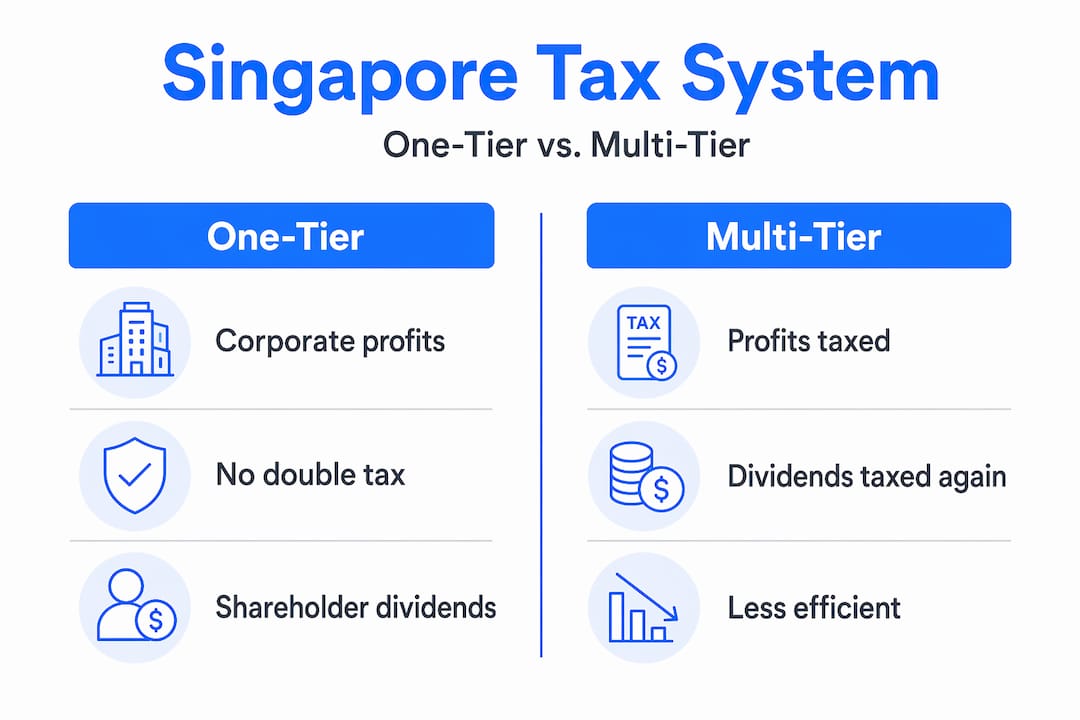
The foundation is the one-tier corporate tax system. Under this model, profits are taxed once at the company level. When those after-tax profits are distributed as dividends to shareholders, no additional tax is applied. Compare that to jurisdictions where dividends are taxed again at the individual level, and the difference in net returns to investors becomes significant over time.
The headline corporate tax rate sits at 17%, but most growing companies pay considerably less. Here is why:
- Startup tax exemption: For the first three years of a company's existence, the first SGD 100,000 of chargeable income is exempt from tax, and the next SGD 100,000 receives a 50% exemption.
- No capital gains tax: Profits from the sale of investments or assets are not taxed, which matters enormously for holding structures and investment vehicles.
- No dividend withholding tax: Shareholders receive dividends without any deduction at source.
- Double Tax Avoidance Agreements: Singapore has DTAs with over 50 countries, reducing withholding taxes on cross-border income flows.
For founders building holding structures or managing profits across multiple jurisdictions, the one-tier dividend system supports centralized cash management without the tax inefficiencies common in other jurisdictions. This is not about avoiding tax. It is about a system designed to prevent double taxation at every level.
Pro Tip: If you are considering a holding company structure, speak with a tax advisor before incorporating. The way you set up share classes and profit distribution from day one will affect your flexibility for years.
The business environment: speed, support, and low friction
Tax efficiency matters less if the regulatory environment is a nightmare. Singapore's strength here is that the two work together.

The Accounting and Corporate Regulatory Authority (ACRA) manages company registration through its BizFile+ platform. Registration typically completes in 1 to 2 business days for straightforward cases, assuming name approval goes smoothly. That speed is not accidental. It reflects a deliberate government policy to reduce friction for business formation.
Singapore has ranked number one by the World Bank for ease of doing business for multiple consecutive years. That ranking reflects real operational conditions: low bureaucracy, fast approvals, transparent regulations, and a legal system built on English common law that international businesses understand and trust.
Beyond the registration process, the government actively supports businesses through grants and incentive programs. Here are the most relevant for early-stage companies:
- Enterprise Development Grant (EDG): Supports companies in building capabilities, expanding overseas, and upgrading operations.
- Startup SG Founder: Provides mentorship and a startup capital grant of up to SGD 50,000 for qualifying first-time entrepreneurs.
- Productivity Solutions Grant (PSG): Subsidizes adoption of pre-approved technology solutions and digital tools.
- Market Readiness Assistance (MRA) Grant: Helps companies expand into new international markets by co-funding eligible costs.
Anti-corruption measures are also worth noting. Singapore consistently ranks among the least corrupt countries in the world. For businesses operating across Asia, where corruption risk varies widely by market, having a Singapore-incorporated entity as the clean holding point in a regional structure carries real reputational and operational value.
Pro Tip: Many government grants require your company to be incorporated in Singapore and have local employees. If you plan to access these programs, factor that into your hiring and structuring decisions early.
Location, infrastructure, and the talent advantage
There is a reason experienced founders use Singapore as a regional headquarters when scaling across Asia. The geographic and infrastructural advantages are not marketing language. They are operational realities.
Singapore sits at the center of Southeast Asia, with direct flight connections to every major Asian city and strong maritime links to the region's manufacturing and trade corridors. For businesses that need to move people, goods, or capital across the region, this location reduces both cost and complexity.
The infrastructure extends beyond transport. Singapore has world-class commercial real estate, reliable digital connectivity, a sophisticated banking sector, and a legal system that enforces contracts predictably. These factors matter when you are choosing where to base regional operations.
| Factor | Singapore | Regional alternatives |
|---|---|---|
| Legal system | English common law, highly predictable | Varies significantly by country |
| Language of business | English as primary language | Often requires translation layer |
| Talent availability | Deep pool of skilled, multilingual professionals | Varies; often requires significant training investment |
| Banking access | Global banks with full corporate services | Restricted in some markets |
| Government stability | Consistent, long-term policy environment | Higher political risk in several alternatives |
| Innovation ecosystem | R&D programs like RIE 2030 with significant funding | Less structured support |
The talent factor deserves specific attention. Singapore has a government-backed startup ecosystem that has attracted global companies and created a workforce experienced in scaling technology and financial services businesses. English is the working language, which eliminates a significant operational barrier that companies face in other Asian markets.
For companies that need to hire senior regional leadership, Singapore's reputation also helps with recruitment. Executives are more willing to relocate to Singapore than to many other cities in the region, which gives incorporated companies a real advantage in talent acquisition.
Practical steps and requirements for incorporation
Understanding the benefits is one thing. Knowing what the process actually involves is another. Here is what you need to account for when planning your Singapore incorporation.
The core requirements for setting up a Private Limited company (Pte Ltd) include:
- Company name: Must be approved by ACRA before filing. Names that are identical to existing companies or contain restricted words are rejected.
- Directors: At least one director must be ordinarily resident in Singapore. This can be a Singapore citizen, permanent resident, or Employment Pass holder. A foreign founder who is not resident can appoint a nominee director to satisfy this requirement.
- Shareholders: Between 1 and 50 shareholders are allowed. Foreign individuals can own 100% of the company with no requirement for a local partner or shareholder.
- Company secretary: A qualified company secretary must be appointed within six months of incorporation. This role handles statutory compliance and ACRA filings.
- Registered address: A local Singapore address is required. This cannot be a P.O. box.
- Paid-up capital: The minimum is SGD 1. There is no requirement to have significant capital at the point of registration.
Once incorporated, companies have ongoing obligations. Annual general meetings, financial statement preparation, and annual returns filed with ACRA are standard requirements. Companies above certain revenue thresholds must also have their accounts audited.
For foreign founders specifically, the step-by-step incorporation process involves additional planning around the nominee director arrangement and, if you plan to relocate, the Employment Pass application. These are manageable steps, but they require proper sequencing to avoid delays.
The cost of incorporating in Singapore is low relative to the benefits. Government fees for name reservation and company registration total a few hundred Singapore dollars. The main costs come from professional services: a corporate secretary, registered address, and any advisory fees for structuring.
My honest take on the Singapore incorporation decision
I have worked with founders at every stage of the incorporation decision, and the pattern I see most often is this: the ones who choose Singapore purely for tax reasons often underestimate how much the broader environment contributes to their actual business outcomes.
In my experience, the operating environment is what compounds over time. The policy stability and talent access that Singapore offers often outweigh raw tax rates when founders reflect on the decision two or three years in. A company that can hire senior talent, access government grants, bank without friction, and operate under a predictable legal system grows faster than one that saved a few percentage points on tax but struggled with everything else.
The misconception I push back on most often is that Singapore incorporation is primarily a tax play for sophisticated investors. It is not. It is a business infrastructure decision. The tax benefits are real and meaningful, but they are one component of a system that is designed to help companies operate and scale efficiently.
What I tell founders who are on the fence: run the numbers on tax, yes. But also ask yourself where you want to be headquartered when you are pitching your Series A to an Asian investor, hiring your regional VP, or opening a bank account for a subsidiary in Indonesia. Singapore answers all three questions better than any alternative in the region right now.
— Terence
How Adept-cs can handle your Singapore incorporation
If you have read this far, you are probably past the "should I do this" stage and into the "how do I actually do this" stage. That is exactly where Adept-cs operates.
Adept Corporate Services handles Singapore company registration from name reservation through to full compliance setup, including corporate secretarial services, registered address, and bank account opening support. The team also manages ongoing obligations so you can focus on running the business rather than tracking ACRA deadlines. For foreign founders who need nominee director arrangements or Employment Pass guidance, Adept-cs provides the full picture, not just the incorporation form. You get a real person, not a chatbot, every time you have a question. Reach out to discuss your specific situation and get a clear path forward.
FAQ
What is the corporate tax rate in Singapore?
Singapore's headline corporate tax rate is 17%, but startups benefit from significant exemptions that reduce the effective rate substantially in the first three years of operation.
Can a foreigner own 100% of a Singapore company?
Yes. Foreign individuals can own 100% of a Singapore Private Limited company with no requirement for a local partner or shareholder.
How long does it take to incorporate in Singapore?
For straightforward cases, incorporation via BizFile+ typically completes within 1 to 2 business days after name approval.
Do I need to be in Singapore to incorporate a company there?
No. You can incorporate remotely, but you must appoint at least one director who is ordinarily resident in Singapore. Foreign founders commonly use a nominee director service to satisfy this requirement.
Are dividends taxed in Singapore?
Under Singapore's one-tier tax system, dividends are not taxed at the shareholder level. Profits are taxed once at the company level, and distributions to shareholders carry no additional tax.
Recommended
- Singapore Company Registration: Your Gateway to Business Success | Adept Corporate Services
- Starting and Setting Up a Business or Company in Singapore | Adept Corporate Services
- Why Singapore is the Best Place to Start a Company as a Foreigner in 2025 | Adept Corporate Services
- A Complete Guide to Corporate Services and Company Formation in Singapore | Adept Corporate Services