
A Limited Liability Partnership (LLP) in Singapore is a separate legal entity that combines the operational flexibility of a traditional partnership with the liability protection of a company. Established under the Limited Liability Partnerships Act 2005, the Singapore LLP structure gives partners the ability to own property, enter contracts, and conduct business in the entity's own name, while shielding each partner's personal assets from the debts and obligations of the business. For entrepreneurs in professional services, consulting, or advisory fields, this structure deserves serious consideration before defaulting to a private limited company.
What are the key features and benefits of a Singapore LLP?
The LLP's separate legal personality is the structural foundation that distinguishes it from a conventional general partnership. The LLP can sue and be sued, hold assets, and sign agreements in its own name. This matters practically: if a client dispute escalates to litigation, the claim is against the LLP, not the individual partners personally.
Limited liability is the defining protection. Each partner's personal financial exposure is limited to their agreed contribution, provided they have not acted fraudulently or with personal negligence. This contrasts sharply with a sole proprietorship or general partnership, where personal assets are fully at risk.

The LLP structure also offers genuine management flexibility. Partners can define their own profit-sharing ratios, decision-making authority, and operational responsibilities through a partnership agreement, without the rigid governance requirements that apply to a private limited company under the Companies Act. There is no minimum or maximum number of partners beyond the statutory minimum of two.
From a cost perspective, LLPs benefit from:
- No mandatory audit requirement for most LLPs, reducing annual compliance costs
- Lower registration fees compared to incorporating a private limited company
- No minimum paid-up capital requirement at formation
- Simplified annual filing through the Annual Declaration process rather than full financial statements
Pro Tip: Draft a detailed LLP partnership agreement before registration. The Act does not prescribe internal governance terms, so without a written agreement, disputes over profit allocation or management authority default to statutory provisions that may not reflect your intentions.
How do you register and set up an LLP in Singapore?
The LLP formation process in Singapore follows a defined sequence through the Accounting and Corporate Regulatory Authority (ACRA). Understanding each step prevents delays and avoids compliance gaps from day one.
-
Confirm partner and manager eligibility. The LLP requires at least two partners and at least one manager who is a Singapore resident aged 18 or above. Partners can be individuals or corporate entities. Foreign entrepreneurs must confirm they have a qualifying resident manager in place before proceeding.
-
Reserve your LLP name. Submit a name application through ACRA's BizFile+ portal. Reserved names are valid for four months with no extension available, so proceed promptly once approved. The name must not be identical or similar to an existing registered entity.
-
Register the LLP with ACRA. Submit the registration application with details of all partners, the appointed manager, the registered business address, and the principal business activity codes. ACRA typically approves straightforward applications within one to three business days.
-
Obtain your UEN and set up Corppass. The Unique Entity Number (UEN) is issued upon registration and is required for all regulatory filings, tax submissions, and bank account applications. Corppass is the digital identity system for accessing government portals, including IRAS and ACRA.
-
Set up the Register of Registrable Controllers (RORC) immediately. This is not optional or deferrable. The RORC must be established at or shortly after registration and filed with ACRA unless the LLP qualifies for an exemption. Controllers are individuals or entities that hold significant ownership or control over the LLP.
-
Execute your partnership agreement. While not a statutory filing requirement, the agreement governs profit allocation, management authority, partner exit provisions, and dispute resolution. It should be signed before the LLP begins operations.
Pro Tip: Residency and role eligibility for managers and partners should be evaluated during business planning, not at the point of registration. Foreign-owned businesses that discover they lack a qualifying resident manager at the filing stage face delays that can affect client commitments and contract timelines.
What are the ongoing compliance obligations for Singapore LLPs?
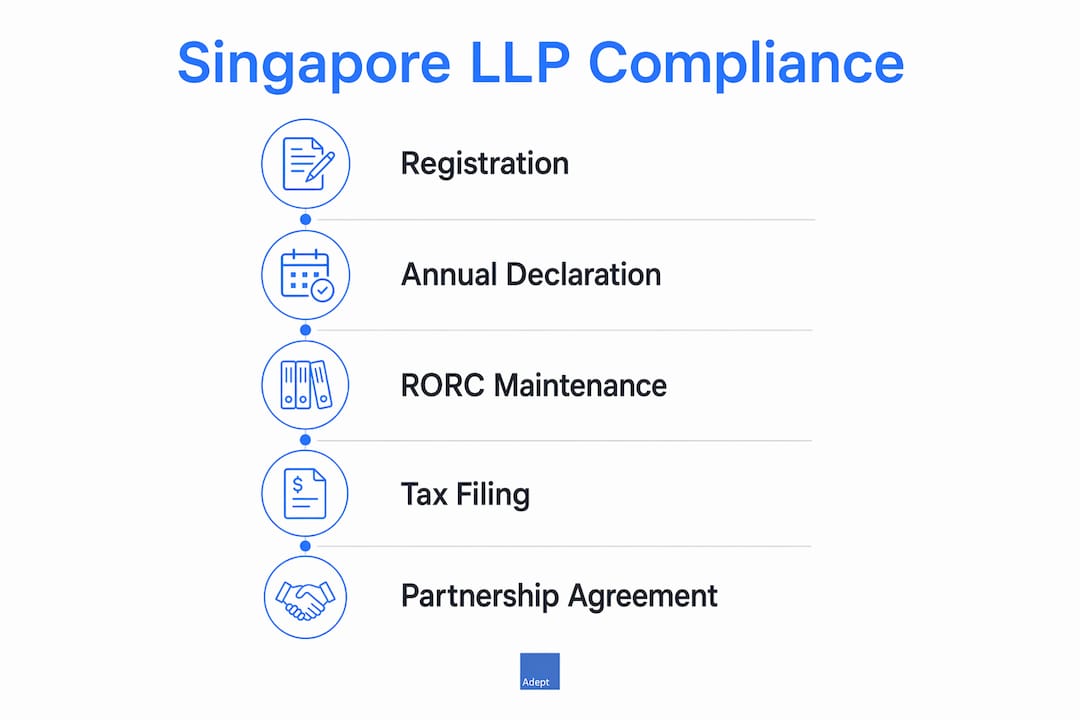
The Singapore LLP structure carries a defined set of recurring compliance duties. Treating these as administrative afterthoughts is one of the most common and costly mistakes entrepreneurs make.
Annual Declaration
The first Annual Declaration must be filed within 15 months of LLP registration. Subsequent declarations are due within 15 months of the previous declaration date. This filing confirms that the LLP is still active and that its registered details remain current. It is not a financial statement, but it is a statutory obligation with real consequences for non-compliance.
RORC maintenance
The RORC is not a one-time setup task. Any change in the identity, ownership percentage, or control status of a registrable controller must be updated promptly. The RORC filing requirements were updated with effect from June 16, 2025, tightening the timelines and scope of disclosure obligations.
Tax filing obligations
LLP partners are taxed individually on allocated profits, not at the entity level. The LLP files a partnership income tax return (Form P) with the Inland Revenue Authority of Singapore (IRAS), and each partner then declares their allocated share on their personal or corporate tax return. Accurate profit and loss allocations between partners are therefore both a tax and a governance matter.
Key compliance dates and obligations at a glance:
| Obligation | Timing and Notes |
|---|---|
| RORC setup and filing | At or shortly after registration; update on any change |
| Annual Declaration | Within 15 months of registration, then annually |
| Partnership tax return (Form P) | Filed with IRAS for each year of assessment |
| Partner income declarations | Each partner files individually based on allocated share |
| Manager residency confirmation | Ongoing; must maintain at least one qualifying resident manager |
Pro Tip: Use a statutory compliance calendar to track LLP filing deadlines alongside your business operations calendar. Missing the Annual Declaration window or failing to update the RORC can trigger penalties and registration revocation, which is a disproportionate consequence for an otherwise compliant business.
How does a Singapore LLP compare to a private limited company?
Choosing between an LLP and a private limited company (Pte Ltd) is one of the most consequential decisions in the Singapore business formation process. The LLP structure suits professional services partnerships seeking limited liability with flexibility, while the Pte Ltd structure is favored for growth-oriented businesses seeking external investment.
| Feature | Singapore LLP | Private Limited Company (Pte Ltd) |
|---|---|---|
| Legal status | Separate legal entity | Separate legal entity |
| Liability protection | Limited per partner | Limited per shareholder |
| Tax treatment | Partners taxed individually | Corporate tax at entity level (17% headline rate) |
| Audit requirement | Generally exempt | Required above certain thresholds |
| Investor suitability | Limited; no share issuance | High; equity and preference shares available |
| Management structure | Flexible partnership agreement | Directors and shareholders governed by Companies Act |
| Typical use case | Law firms, accounting practices, consultancies | Tech startups, trading companies, growth businesses |
The tax treatment difference is significant. LLP partners pay personal income tax on their share of profits, which can be advantageous for higher-earning partners in lower tax brackets. A Pte Ltd pays corporate tax at the entity level, and shareholders receive dividends from after-tax profits. Neither structure is universally superior; the right choice depends on your revenue profile, growth plans, and investor requirements.
One limitation of the LLP worth acknowledging directly: it cannot issue shares. This means raising equity capital from external investors is structurally not possible within the LLP framework. If your business plan includes a funding round or eventual exit via acquisition, a Pte Ltd is the more appropriate vehicle from the outset.
Key takeaways
The Singapore LLP structure is the most practical choice for professional services entrepreneurs who need limited liability protection, flexible internal governance, and lower compliance costs than a private limited company.
| Point | Details |
|---|---|
| Separate legal entity | The LLP owns assets and enters contracts in its own name, protecting partners personally. |
| Immediate RORC obligation | RORC must be set up and filed with ACRA at or shortly after registration, not deferred. |
| Annual Declaration deadline | First filing is due within 15 months of registration; missing it risks penalties and revocation. |
| Partner-level taxation | Each partner is taxed individually on their profit share; the LLP itself does not pay corporate tax. |
| LLP vs Pte Ltd | LLPs suit professional practices; Pte Ltds suit growth businesses requiring equity investment. |
Why the RORC and Annual Declaration deserve more attention than they get
Most entrepreneurs focus on name registration and partnership agreements when forming an LLP. In practice, the two obligations that create the most compliance risk are the RORC and the Annual Declaration, and both are frequently underestimated.
The RORC is not a formality. It is a transparency mechanism that regulators take seriously, and the 2025 updates to filing requirements raised the bar for disclosure timelines and controller identification. We have seen businesses that registered cleanly but then failed to update the RORC when a partner's ownership structure changed, creating a compliance gap that required remediation work well after the fact.
The Annual Declaration is similarly underestimated because it does not involve financial statements. Entrepreneurs assume that if there is nothing significant to report, the filing can wait. That assumption is wrong. The 15-month window runs from the registration date, not the financial year end, and ACRA's enforcement posture on late declarations has become more consistent.
Our practical advice: treat LLP formation as a compliance-driven documentation project from day one. Appoint your resident manager before you submit the registration application. Execute your partnership agreement before the LLP begins operations. Set up the RORC the same week as registration. And put the Annual Declaration deadline in your calendar the day you receive your UEN.
The LLP structure rewards disciplined operators. The flexibility it offers in management and profit sharing is genuine, but that flexibility only holds value if the underlying compliance obligations are met without gaps.
— Wandy & Terence
How Adept Corporate Services supports your LLP formation and compliance
Adept Corporate Services provides end-to-end support for entrepreneurs setting up and operating a Singapore LLP. From company registration and formation through to ongoing corporate secretarial compliance, the team at Adept manages the RORC setup, Annual Declaration filings, and partnership tax return coordination so that nothing falls through the gaps. For entrepreneurs who want expert guidance on structuring partner agreements or evaluating whether an LLP or Pte Ltd better fits their business model, Adept's advisory team provides direct, personalized counsel. Explore Adept's corporate secretarial services or contact the team directly to discuss your LLP formation requirements.
FAQ
What is a Singapore LLP?
A Singapore LLP is a separate legal entity created under the Limited Liability Partnerships Act 2005, combining partnership flexibility with limited liability protection for each partner. It can own property, enter contracts, and conduct business in its own name.
How many partners does a Singapore LLP require?
A Singapore LLP requires a minimum of two partners and at least one manager who is a Singapore resident aged 18 or above. There is no maximum limit on the number of partners.
How is a Singapore LLP taxed?
The LLP does not pay corporate tax at the entity level. Instead, each partner is taxed individually on their allocated share of the LLP's profits through their personal or corporate income tax return.
What is the RORC and when must it be filed?
The Register of Registrable Controllers (RORC) identifies individuals or entities with significant ownership or control over the LLP. It must be set up and filed with ACRA at or shortly after LLP registration, and updated whenever a controller's details change.
When is the first Annual Declaration due for a Singapore LLP?
The first Annual Declaration must be filed with ACRA within 15 months of the LLP's registration date. Subsequent declarations are due within 15 months of the previous filing, making it a recurring annual obligation.
Recommended
- Starting and Setting Up a Business or Company in Singapore | Adept Corporate Services
- Singapore Company Registration: Your Gateway to Business Success | Adept Corporate Services
- What foreigners must know about setting up a company in Singapore | Adept Corporate Services
- Why Singapore is the Best Place to Start a Company as a Foreigner in 2025 | Adept Corporate Services