
Singapore's investment incentive framework is one of the most sophisticated in Asia, but most investors misread it. The common assumption is that these programs amount to simple tax cuts you apply for and receive. The reality of this singapore investment incentives overview is more demanding and more rewarding. These programs require genuine operational substance, strategic business planning, and careful alignment with evolving international tax rules. With Budget 2026 extending key regimes and Singapore adapting to OECD Pillar Two reforms, the stakes for getting this right have never been higher.
Table of Contents
- Key Takeaways
- Key investment incentives available in Singapore for 2026
- Eligibility, approval, and operational requirements
- Integrating incentives into tax planning under Pillar Two
- Practical tips for IP tax incentives in Singapore
- Choosing the right mix of Singapore incentives
- My take on getting this right in 2026
- How Adept-cs helps you access Singapore's incentives
- FAQ
Key Takeaways
| Point | Details |
|---|---|
| Substance over structure | Singapore incentives reward real operational activity, not paper setups or holding arrangements. |
| RIC is OECD-aligned | The Refundable Investment Credit is designed to survive Pillar Two minimum tax rules as a Qualified Refundable Tax Credit. |
| EIS has hard caps | The Enterprise Innovation Scheme gives 400% deductions but caps qualifying spend per category per year of assessment. |
| IP ownership matters | Writing-down allowances for intellectual property require both legal and economic ownership, or formal EDB approval for exceptions. |
| Early engagement wins | Contacting EDB or EnterpriseSG before incurring qualifying costs dramatically improves your application outcome. |
Key investment incentives available in Singapore for 2026
The types of Singapore tax incentives available today cover a wide spectrum, from concessionary corporate tax rates to refundable cash credits and enhanced deductions. Understanding each one's mechanics is what separates businesses that extract real value from those that leave benefits unclaimed.
Development and Expansion Incentive (DEI)
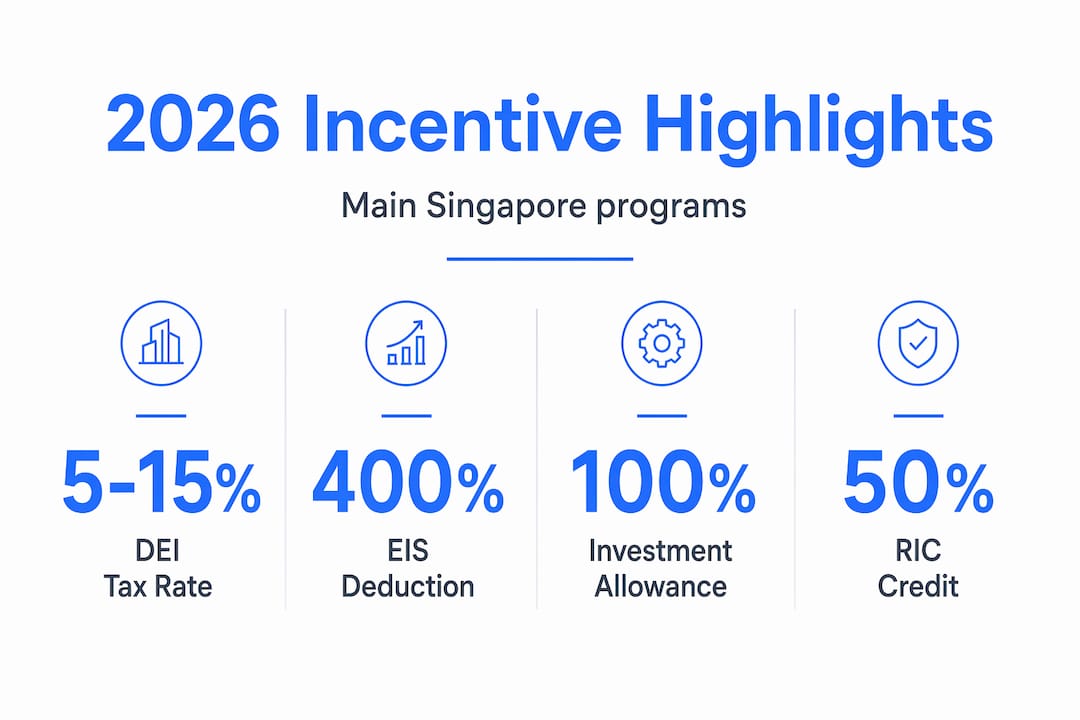
The DEI is the flagship incentive for companies expanding substantive operations in Singapore. It provides concessionary tax rates of 5%, 10%, or 15% on qualifying income, typically for an initial five-year period that can extend to 40 years in total. The DEI targets high-value manufacturing, headquarters activities, and selected services. The rate you receive depends on the nature and scale of your commitment.

Enterprise Innovation Scheme (EIS)
Introduced for YA 2024 to 2028, the EIS grants 400% tax deductions on qualifying innovation expenditures, capped at SGD 400,000 per qualifying category per year of assessment. Qualifying categories include R&D, IP registration, IP licensing, employee training, and innovation projects with polytechnics or universities. A business that hits the cap across multiple categories can unlock significant tax relief. The EIS category-specific caps make planning your spend across years and categories a strategic exercise, not a passive one.
Investment Allowance
The Investment Allowance provides tax exemptions on up to 100% of qualifying capital expenditure incurred over five years, or eight years for hire-purchase assets. For automation investments, the cap is SGD 10 million per project. This is particularly powerful for capital-intensive businesses building out production or technology infrastructure in Singapore.
Refundable Investment Credit (RIC)
Introduced in 2024, the RIC is arguably the most significant structural shift in Singapore's incentive toolkit. It offers refundable tax credits of up to 50% on qualifying expenditures for up to ten years. Unused credits are refunded in cash within four years. The RIC was deliberately structured as a Qualified Refundable Tax Credit under OECD GloBE rules, meaning it does not erode a multinational group's effective tax rate in the same way traditional tax holidays do.
Regime extensions and IP allowances
Budget 2026 extends the Finance and Treasury Centre (FTC) and Global Trader Programme (GTP) regimes to December 31, 2031, providing certainty for treasury and trading operations. For IP-focused businesses, writing-down allowances for intellectual property acquisitions remain a powerful tool, though subject to strict ownership and cost eligibility rules covered in a later section.
| Incentive | Tax Benefit | Qualifying Activities | Approval Body |
|---|---|---|---|
| DEI | 5–15% concessionary rate | Manufacturing, HQ, selected services | EDB |
| EIS | 400% deductions (capped) | R&D, IP, training, innovation | Self-assessed with IRAS |
| Investment Allowance | Up to 100% on capex | Capital investment, automation | EDB |
| RIC | Up to 50% refundable credit | High-value economic activities | EDB |
| IPR Writing-Down Allowances | Capital cost write-off | IP acquisition and ownership | IRAS / EDB waiver |
Eligibility, approval, and operational requirements
Getting approved for these programs is not a paperwork exercise. Approval depends on proving substantive economic activity in Singapore, including skilled local employment, R&D contribution, and demonstrated regional expansion strategies. The agencies reviewing applications are looking for businesses that anchor real value in Singapore, not those routing income through for tax purposes.
Here is how the approval process typically works for incentive-backed applications:
- Identify the target incentive. Confirm which scheme aligns with your industry, capital plan, and operational model before you spend anything.
- Prepare a detailed business plan. Agencies like the Economic Development Board (EDB) and EnterpriseSG expect specific commitments on headcount, local expenditure, and economic output targets.
- Demonstrate technology anchoring. Applications score better when they show how the Singapore entity will create or transfer skills and capabilities, not just use the country as a base.
- Submit a prior-approval application. Incentives like the DEI, Investment Allowance, and RIC require pre-approval. EIS is largely self-assessed, but you still need documentation in place before claiming.
- Meet ongoing compliance requirements. Incentive awards include conditions. You must meet employment and expenditure thresholds annually, and agencies conduct reviews to confirm continued compliance.
Pro Tip: Map every planned expenditure against the qualifying categories of your target incentive before you sign contracts or incur costs. Expenditure that does not fit a qualifying category cannot be retroactively restructured, and the financial impact is real.
The most common failure in incentive applications is underestimating how much weight agencies place on substance. A business plan that describes a lean holding company or a small representative office will not secure a DEI or RIC award. Approvals go to companies that commit to real activity: engineers hired locally, R&D run from Singapore, regional decision-making based in the entity.
Integrating incentives into tax planning under Pillar Two
The OECD Pillar Two framework establishes a global minimum effective tax rate (ETR) of 15% for large multinational groups. Singapore enacted the Multinational Enterprise (Minimum Tax) Act in 2025, meaning groups with consolidated revenues over EUR 750 million are subject to a domestic top-up tax. This changes how you model the investment benefits in Singapore for your group.
Traditional tax holidays, where a company pays zero or near-zero tax on qualifying income, can reduce a group's ETR below 15% and trigger top-up tax payable elsewhere in the group. The RIC was specifically designed to sidestep this problem:
- Qualified Refundable Tax Credit treatment. Because the RIC is refundable and meets OECD QRTC criteria, it is treated as income under GloBE rules rather than as a reduction of covered taxes, leaving the ETR calculation relatively intact.
- EIS deductions require ETR modeling. The 400% deductions under EIS can reduce taxable income significantly, which compresses the local ETR. For groups subject to Pillar Two, this may shift top-up tax liability to the parent jurisdiction.
- Timing and cap planning for EIS. Planning around EIS caps and timing prevents both lost deductions and unintended ETR compression in years where the benefit would trigger minimum tax consequences.
- Group-level modeling is non-negotiable. Local tax advisors must coordinate with group tax teams to model how Singapore incentives interact with the group ETR and where any top-up tax liability ultimately lands.
Singapore's RIC was introduced precisely to maintain investment attractiveness in a post-Pillar Two world. It is the clearest signal yet that Singapore is not abandoning competitiveness. It is reengineering it. Singapore Brings Refundable Investment Credits Regime Into Force
For businesses below the EUR 750 million threshold, Pillar Two does not directly apply, but the framework still shapes how Singapore designs and refreshes its incentive programs going forward. Even smaller investors benefit from understanding this shift.
Practical tips for IP tax incentives in Singapore
The singapore ip tax incentive explained in simple terms: Singapore allows businesses to write down the capital cost of acquired intellectual property rights (IPRs) over five years, which can be accelerated under the EIS framework. It sounds straightforward. In practice, the rules have sharp edges.
- Excluded costs. Legal fees, registration costs, and stamp duties) do not count as qualifying capital expenditure for writing-down allowances. You must isolate the pure acquisition price from all ancillary transaction costs.
- Dual ownership requirement. You must hold both legal and economic ownership of the IPR to claim allowances. If your structure separates these (for example, a legal owner in one jurisdiction and a beneficial owner in another), you need EDB approval to waive this requirement.
- Claw-back risk. If you dispose of the IPR before meeting the minimum ownership period, previously claimed allowances are subject to claw-back. Plan your ownership timeline carefully before structuring any IP transfers.
- Accelerated allowances under EIS. For qualifying IP registration and licensing expenditure, EIS allows 400% deductions within the SGD 400,000 annual cap, which accelerates the economic benefit substantially compared to standard write-downs.
Pro Tip: Maintain a dedicated cost ledger that separates qualifying IP acquisition costs from excluded transaction costs from day one. IRAS audits of IP claims frequently focus on this segregation, and a clean ledger is your best defense.
Documenting IP ownership) and segmenting costs is as critical as the tax rate itself for a successful IP writing-down allowance claim. Businesses that treat this as a year-end tax exercise rather than an ongoing operational discipline consistently miss out.
Choosing the right mix of Singapore incentives
No single incentive suits every business. The right combination depends on your industry, capital profile, innovation intensity, and timeline. Use this comparison to orient your thinking:
| Business Type | Best Fit Incentive | Why |
|---|---|---|
| High-value manufacturer expanding capex | Investment Allowance + DEI | Capital cost relief plus low rate on qualifying income |
| Tech company with active R&D and IP registration | EIS + IPR Write-Down | 400% deductions accelerate cost recovery on innovation spend |
| Large MNC making major investment commitment | RIC | Refundable credit survives Pillar Two ETR modeling |
| Regional treasury or trading hub | FTC or GTP regime | Concessionary rates on qualifying treasury or trading income |
| Startup or SME below Pillar Two threshold | EIS + partial tax exemption | Accessible without prior approval, strong cash flow benefit |
A few principles worth applying when making your selection:
- Start with your actual operations, not the tax benefit. The incentive that fits your business model will always be more defensible and more durable than one you have engineered your operations around.
- Engage EDB or EnterpriseSG early, ideally before your investment decision is final. Both agencies are genuinely interested in attracting the right investments and will give you meaningful feedback on your application's prospects.
- Consider how to invest in Singapore as a multi-incentive strategy. Most businesses that maximize their outcomes use two or three programs in combination rather than relying on a single scheme.
For a full breakdown of tax exemption schemes, including how the partial tax exemption applies to new and existing companies, the details matter significantly for your financial modeling.
My take on getting this right in 2026
In my experience working with investors and businesses structuring their Singapore presence, the single biggest mistake I see is treating incentives as the strategy rather than as a component of it. Companies that go to EDB with a genuine business case, backed by real commitments on jobs and R&D, get approved. Companies that come with a tax-optimized structure in search of a framework to hang it on do not.
I have also noticed that the documentation burden is consistently underestimated. Whether it is maintaining cost ledgers for IP claims or internal approval gates for EIS spend, the businesses that succeed at these programs treat compliance as a core operational function. They involve finance, tax, HR, and engineering teams in qualifying decisions before money is spent, not after.
The shift to Pillar Two compatibility is genuinely positive for serious investors. It signals that Singapore's approach to staying competitive is about substance and innovation capacity, not rate arbitrage. The S$37 billion allocated for research and innovation through 2030 reinforces this. The incentives are generous, but they flow to businesses that actually build something here.
If you are approaching this strategically, the question is not "which incentive gives me the lowest tax rate?" It is "how do I build a Singapore operation substantive enough to qualify for these programs and sustain the commitment?" That framing changes everything about how you plan.
— Terence
How Adept-cs helps you access Singapore's incentives
Understanding the programs is step one. Executing on them is where most businesses need support.
Incentive applications involve coordinating business plans, employment projections, capital expenditure schedules, and legal documentation across multiple agencies. Getting any part of this wrong can delay approval or disqualify spend that should have qualified. Adept Corporate Services works directly with investors and business owners to structure their Singapore presence correctly from the start. Whether you are looking at company registration in Singapore to establish an entity eligible for the DEI or RIC, or you need ongoing tax compliance support to maintain your incentive conditions year after year, the Adept-cs team provides real guidance from people who understand both the technical and practical dimensions of these programs. No automated responses. No generic checklists. Just direct access to experienced professionals who have done this before.
FAQ
What is the Refundable Investment Credit in Singapore?
The RIC provides refundable tax credits of up to 50% on qualifying expenditures for up to ten years, with unused credits paid out as cash within four years. It was designed to align with OECD Pillar Two rules as a Qualified Refundable Tax Credit.
How does the Enterprise Innovation Scheme work?
EIS grants 400% tax deductions on qualifying innovation spending, including R&D, IP registration, licensing, and training, capped at SGD 400,000 per category per year of assessment between YA 2024 and 2028.
What does "substantive economic activity" mean for incentive approval?
It means demonstrating real operations in Singapore, including skilled local employees, R&D activity, and genuine business decision-making based in your Singapore entity. Agencies assess business plans, local spending commitments, and employment targets.
Are Singapore tax incentives affected by Pillar Two?
Traditional tax holidays can reduce a multinational group's ETR below the 15% minimum and trigger top-up tax elsewhere in the group. The RIC is specifically structured to avoid this problem, making it the preferred incentive for large multinational groups subject to Pillar Two.
What costs are excluded from IP writing-down allowances?
Legal fees, registration costs, and stamp duties paid to acquire intellectual property rights do not qualify as capital expenditure for writing-down allowances. Only the core acquisition price of the IPR counts toward the claim.
Recommended
- Singapore Budget 2026 | Adept Corporate Services
- Singapore Single Family Office 2026 Guide | Adept Corporate Services
- Why Singapore is the Best Place to Start a Company as a Foreigner in 2025 | Adept Corporate Services
- Investment Holding Companies in Singapore & tax treatment | Adept Corporate Services