
A Singapore intellectual property holding structure is a dedicated corporate entity established to own, manage, and commercially exploit intellectual property assets, separating them from operating companies to maximize protection and tax efficiency. Singapore's combination of a territorial tax system, the Intellectual Property Development Incentive (IDI), and robust IP laws administered by the Intellectual Property Office of Singapore (IPOS) makes it one of Asia's most strategically sound jurisdictions for IP holding. The Income Tax Act, transfer pricing rules, and writing-down allowances create a statutory framework that rewards companies who structure IP ownership correctly. This guide explains the legal basis, protection mechanisms, structural models, and practical setup steps every entrepreneur needs to know before committing to an IP holding strategy in Singapore.
What legal and tax frameworks govern Singapore IP holding structures?
The statutory foundation for a Singapore intellectual property holding structure rests on the Income Tax Act, particularly the transfer pricing provisions under Section 34D, which requires that all intra-group royalty and licensing arrangements reflect arm's-length pricing. This means the royalty rate your Singapore IP holding company charges its operating subsidiaries must be defensible against what an independent third party would pay. IRAS takes this seriously, and a rate that appears artificially inflated or deflated will attract scrutiny.
The Intellectual Property Development Incentive (IDI) offers concessionary tax rates on qualifying IP income, including royalties and licensing fees derived from patents and innovations developed or substantially managed in Singapore. To access these rates, the IP must be actively used in a Singapore trade or business, not merely parked in a holding entity. This distinction between active management and passive holding is the single most consequential compliance issue for IP holding companies.
Transfer pricing documentation under the Income Tax (Transfer Pricing Documentation) Rules 2018 requires contemporaneous records, meaning documentation must exist at the time the transaction occurs, not after IRAS raises a query. Failure to maintain these records can result in IRAS adjustments that eliminate the tax benefit entirely. For IP transfers into Singapore entities, valuation complexity is high, and agreements often include contingent adjustment clauses to manage the risk of IRAS challenging the initial valuation.
Key compliance requirements for your IP holding structure include:
- Contemporaneous transfer pricing documentation covering all intra-group royalty and licensing transactions
- Arm's-length pricing analysis supported by benchmarking studies or independent valuations
- Writing-down allowance claims requiring both legal and economic ownership of the IP, plus active use in Singapore business
- Withholding tax management on royalties paid to non-resident licensees, currently at 10% for most treaty partners under Singapore's extensive double tax agreement network
- Annual review of IDI eligibility to confirm the IP income continues to qualify under the incentive conditions
Pro Tip: Engage a Singapore tax advisor before transferring IP into a holding entity. The valuation at the point of transfer determines your writing-down allowance base, and an undervalued transfer is very difficult to correct retrospectively.
How does Singapore IP protection work for different asset types?
Singapore intellectual property protection options differ significantly by asset type, and an IP holding company must register and maintain each category through the correct mechanism. Understanding these distinctions is not merely administrative. It directly affects the commercial value of the IP assets held and the enforceability of licensing arrangements.
-
Patents. A Singapore patent grants the holder exclusive rights for 20 years from the filing date, covering inventions that are new, involve an inventive step, and are industrially applicable. The holding company must be the registered owner of the patent for licensing income to flow correctly and for writing-down allowances to apply. Singapore's patent system is administered by IPOS and is compatible with the Patent Cooperation Treaty (PCT), allowing international filings from a single Singapore application.
-
Trademarks. Trademark registration at IPOS provides protection for an initial 10-year term, renewable indefinitely in 10-year increments. Electronic filing using descriptions from the IPOS Classification Database costs S$280 per class and significantly reduces the likelihood of objections from the registry. For an IP holding company managing a portfolio of brands across multiple operating entities, correct class selection at the point of registration is critical. Errors in classification require separate applications and additional fees to correct.
-
Trade secrets. Singapore protects trade secrets through the law of confidence rather than a registration system, meaning protection has no time limit but depends entirely on the owner taking reasonable steps to maintain confidentiality. Non-disclosure agreements, access controls, and confidentiality clauses in employment contracts are the primary tools. If a dispute arises, the IP holding company must demonstrate that these measures were in place and consistently enforced.
-
Copyright. Copyright protection in Singapore is automatic upon creation of an original work and requires no registration. The holding company should maintain clear records of creation dates, authorship, and assignment agreements to establish ownership, particularly when copyright has been transferred from an individual creator or an operating subsidiary.
Pro Tip: For trade secrets specifically, treat confidentiality as an ongoing operational discipline rather than a one-time legal formality. IPOS guidance confirms that layered access controls and incident response readiness are what distinguish enforceable trade secret claims from unenforceable ones.
What structural models do Singapore IP holding companies use?
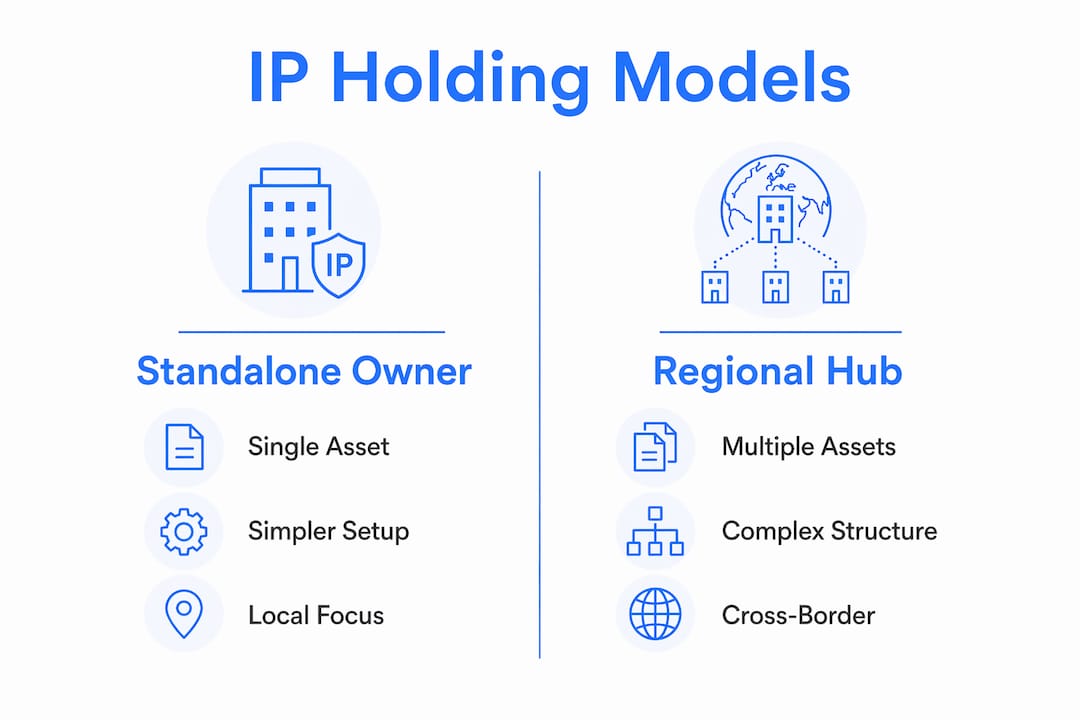
The two most common configurations for an IP holding company structure in Singapore are the standalone IP owner and the regional group IP hub. Each carries distinct substance requirements and risk profiles.

| Feature | Standalone IP owner | Regional group IP hub |
|---|---|---|
| Ownership scope | Single IP asset or portfolio | Group-wide IP across multiple jurisdictions |
| Licensing model | Direct license to one operating entity | Sub-licensing to multiple regional subsidiaries |
| Substance requirements | Board oversight, local management decisions | Full IP management team, R&D coordination |
| Tax incentive access | IDI possible with active use | IDI and enhanced writing-down allowances available |
| Compliance complexity | Moderate | High, requires robust transfer pricing framework |
| Risk of form-over-substance challenge | Lower if properly managed | Higher without documented board activity and delegation |
The critical risk in both models is the divergence between legal form and economic reality. A company may legally own IP registered in Singapore while all meaningful decisions about its development, licensing strategy, and commercialization are made by executives in another jurisdiction. IRAS and courts have both indicated that genuine management and active exploitation of IP are necessary conditions for tax benefits. Passive holding, where the Singapore entity merely receives royalties while a foreign parent controls all IP decisions, risks denial of incentives and challenges to the ownership claim itself.
Practitioners consistently recommend that board minutes, delegation authority, and licensing decisions be demonstrably tied to the Singapore entity. This means Singapore-based directors must have real authority over IP licensing terms, renewal decisions, and enforcement actions, not merely rubber-stamp decisions made elsewhere.
Understanding your directors' duties and responsibilities in Singapore is therefore not a formality. It is a substance requirement with direct tax consequences.
How to set up and maintain a Singapore IP holding structure
Setting up a Singapore IP holding structure correctly from the outset prevents costly restructuring later. The process involves incorporation, IP registration or transfer, licensing documentation, and ongoing governance.
- Incorporate a Singapore private limited company through ACRA (Accounting and Corporate Regulatory Authority), specifying IP management and licensing as the principal business activities. The company registration process in Singapore is straightforward, but the constitutional documents and share structure should reflect the IP holding purpose from day one.
- Transfer or assign IP assets to the Singapore entity with a properly documented assignment agreement. For patents and trademarks, update the registered owner at IPOS. For trade secrets and copyright, execute written assignment deeds and update internal records.
- Establish intra-group licensing agreements that specify royalty rates, payment terms, sublicensing rights, and enforcement obligations. These agreements must reflect arm's-length terms and be supported by a transfer pricing study before the first royalty payment is made.
- Prepare contemporaneous transfer pricing documentation at the time each intra-group transaction is entered into. Review and update this documentation annually or whenever the licensing terms change materially.
- Implement trade secret governance including confidentiality clauses in all employment contracts, NDAs with third parties, tiered access controls to sensitive information, and a documented incident response process for potential breaches.
- Maintain a statutory compliance calendar covering annual returns, financial statements, and any IDI reporting obligations. Adept Corporate Services provides a 2026 statutory compliance calendar that maps all key filing deadlines for Singapore companies.
- Conduct annual substance reviews where the board formally documents its oversight of IP management decisions, licensing strategy, and enforcement activities. These minutes are your first line of defense in any IRAS inquiry.
For companies holding IP as part of a broader investment holding structure, the tax treatment of income and expenses requires careful segregation to avoid inadvertently mixing IP licensing income with other investment returns, which can complicate IDI claims.
Key takeaways
A Singapore IP holding structure delivers genuine tax and protection benefits only when legal ownership is matched by active, documented management of the IP within Singapore.
| Point | Details |
|---|---|
| Substance over form | Passive IP holding without genuine Singapore-based management risks denial of tax incentives and ownership challenges. |
| Contemporaneous documentation | Transfer pricing records must exist at the time of each transaction, not after an IRAS inquiry is raised. |
| Asset-specific protection | Patents, trademarks, trade secrets, and copyright each require distinct registration or governance steps within the holding structure. |
| Trademark cost efficiency | Filing electronically using the IPOS Classification Database costs S$280 per class and reduces objections significantly. |
| Annual governance reviews | Board minutes documenting IP licensing decisions are the primary evidence of substance in any regulatory review. |
Why most IP holding structures underdeliver, and what actually works
From our experience advising entrepreneurs and corporate groups on Singapore IP management, the most common failure is not legal. It is operational. Business owners incorporate a Singapore entity, transfer IP into it, and then continue running all IP decisions from their home jurisdiction. The legal structure is correct. The economic reality is not.
The assumption that placing IP in Singapore automatically unlocks tax benefits is wrong. IRAS has become increasingly sophisticated in identifying structures where the Singapore entity is a legal shell rather than a genuine commercial owner. We have seen cases where well-drafted licensing agreements and proper IPOS registrations were insufficient because the board of the Singapore entity had no documented involvement in a single licensing decision over a three-year period.
What actually works is treating the Singapore IP holding company as a functioning business unit. That means Singapore-based directors who genuinely review and approve licensing terms, board meetings where IP strategy is on the agenda, and a clear delegation of authority framework that keeps decision-making within the Singapore entity. It also means investing in trade secret governance as a continuous practice. IPOS is explicit that confidentiality is a continuous operational responsibility, not a one-time NDA signing exercise.
On valuation, our advice is to be conservative when transferring IP into Singapore. An aggressive valuation may maximize your writing-down allowance base, but it also creates a larger target for IRAS to challenge. A defensible, independently supported valuation with contingent adjustment clauses is worth far more than a higher number that cannot withstand scrutiny.
The entrepreneurs who get the most from Singapore's IP framework are those who treat compliance as a commercial discipline, not a checkbox exercise.
— Wandy & Terence
How Adept Corporate Services can help with your IP holding setup
Adept Corporate Services works with entrepreneurs and corporate groups at every stage of establishing and maintaining a Singapore IP holding structure, from initial company incorporation through to ongoing statutory compliance and tax advisory.
Our team handles company incorporation, corporate secretarial compliance, and tax advisory services tailored specifically to IP holding entities, including transfer pricing documentation support and IDI eligibility assessments. We also provide corporate secretarial services that keep your substance requirements documented and your statutory filings on schedule. If you are ready to establish your Singapore IP holding company or need a compliance review of an existing structure, contact Adept Corporate Services directly. No chatbots, no automated responses. Just experienced professionals who understand what it takes to make an IP holding structure work.
FAQ
What is a Singapore IP holding structure?
A Singapore IP holding structure is a dedicated corporate entity incorporated in Singapore to own, license, and manage intellectual property assets, separating them from operating companies to achieve tax efficiency and asset protection.
What tax incentives apply to Singapore IP holding companies?
The Intellectual Property Development Incentive (IDI) offers concessionary tax rates on qualifying IP income such as royalties and licensing fees, provided the IP is actively managed and commercially exploited within Singapore.
How does transfer pricing affect intra-group IP licensing in Singapore?
All intra-group royalty arrangements must reflect arm's-length pricing supported by contemporaneous documentation under the Income Tax (Transfer Pricing Documentation) Rules 2018, or IRAS may adjust the taxable income of the Singapore entity.
What is the cost of registering a trademark through IPOS?
Electronic trademark registration using pre-approved descriptions from the IPOS Classification Database costs S$280 per class, with protection lasting 10 years and renewable indefinitely in 10-year increments.
Can trade secrets be protected within a Singapore IP holding structure?
Yes. Singapore protects trade secrets through the law of confidence with no registration requirement and no time limit, but the holding company must demonstrate reasonable confidentiality steps including NDAs, access controls, and documented incident response procedures.
Recommended
- Singapore Single Family Office 2026 Guide | Adept Corporate Services
- Starting and Setting Up a Business or Company in Singapore | Adept Corporate Services
- Investment Holding Companies in Singapore & tax treatment | Adept Corporate Services
- What foreigners must know about setting up a company in Singapore | Adept Corporate Services