Singapore economic substance requirements determine whether gains from foreign asset disposals are taxable income or remain outside Singapore's tax net, based on the demonstrable economic activity an entity maintains within Singapore. Under section 10L of the Income Tax Act, effective from January 1, 2024, any entity receiving foreign asset disposal gains in Singapore without adequate substance faces full income taxation on those gains. This is not a theoretical risk. Holding companies, special purpose vehicles, and regional treasury entities that rely on Singapore's historically favorable tax treatment must now prove their presence is real, not nominal. This guide explains who is covered, how IRAS evaluates substance, and what documentation actually protects you.
What are Singapore economic substance requirements and who must comply?
Singapore economic substance requirements, formally governed by section 10L of the Income Tax Act (ITA), apply to entities that receive or are deemed to receive gains from the disposal of foreign assets in Singapore. The substance over form principle sits at the core of this framework. IRAS does not accept legal registration in Singapore as proof of genuine economic activity. The entity must demonstrate that meaningful business decisions, resources, and operations are actually located here.
Covered entities include Singapore-resident companies and foreign companies with a permanent establishment in Singapore that dispose of foreign assets such as shares in overseas subsidiaries, foreign real property, or other offshore investments. The rules draw a critical distinction between two categories:
- Pure equity-holding entities: Companies whose sole function is holding equity interests in other entities. These face a lighter substance test focused on filing obligations, Singapore-based management, and adequate human resources to carry out that holding function.
- Non-pure equity-holding entities: Companies that also perform other functions such as treasury management, intellectual property licensing, or operational coordination. These face a more demanding assessment covering core income-generating activities, local decision-making, qualified employees, and business expenditures proportionate to their activity.
Special purpose vehicles present a specific challenge. IRAS assesses substance at the entity level, meaning the holding entity that controls and benefits from an SPV's activities is the party evaluated, not the SPV itself. A Singapore parent that directs an offshore SPV but maintains no real operational footprint in Singapore cannot rely on the SPV's activities to satisfy substance.
Certain entities are excluded from section 10L's scope entirely. Regulated financial institutions, real estate investment trusts, and entities whose gains are already taxable as trading income fall outside the economic substance assessment. Qualifying for excluded entity status is the cleanest path to avoiding the rules, and identifying whether your structure qualifies should be the first analytical step.
Pro Tip: Before assessing substance adequacy, confirm whether your entity qualifies as an excluded entity under section 10L. Many structures that generate trading income or fall under MAS regulation are already outside the scope of these rules, making the substance analysis unnecessary.
How does IRAS assess economic substance adequacy?
IRAS applies a qualitative, facts-and-circumstances assessment with no fixed numeric thresholds. No minimum employee count or expenditure floor exists. This means a single qualified director managing a holding portfolio may satisfy substance for a pure equity-holding entity, while a regional treasury center with five staff may still fall short if key decisions are made offshore. Proportionality to the entity's business model and scale is the governing principle.
The assessment criteria differ by entity type, but the following framework applies across both categories:
- Management and control location: Board meetings must reflect genuine deliberation in Singapore. Rubber-stamp approvals of decisions made elsewhere do not satisfy this criterion. Minutes should record substantive discussion, not just outcomes.
- Qualified personnel: The entity must employ or engage individuals with the expertise to carry out its stated functions. For a non-pure equity-holding entity managing cross-border investments, this means people who actually understand and execute those investment decisions.
- Core income-generating activities: The activities that directly produce the income from foreign asset disposals must be performed in Singapore. Outsourcing is permissible under specified IRAS conditions, but the entity must retain oversight and control over outsourced functions.
- Business expenditures: Costs incurred in Singapore, including salaries, professional fees, and office expenses, must be proportionate to the entity's income-generating activity.
- Physical premises: A registered address at a filing agent's office does not constitute adequate premises. The entity needs a workspace where its functions are genuinely performed.
Different criteria apply to pure equity-holding versus non-pure equity-holding entities, so misclassifying your entity type is a compliance error with real tax consequences. A company that holds equity but also provides intercompany loans or centralized services is almost certainly a non-pure equity-holding entity and must meet the higher standard.
Pro Tip: Outsourcing core functions to a Singapore-based service provider can count toward substance, but only if your entity retains documented oversight. Keep records of review meetings, approval emails, and performance assessments to demonstrate that control remains in Singapore.

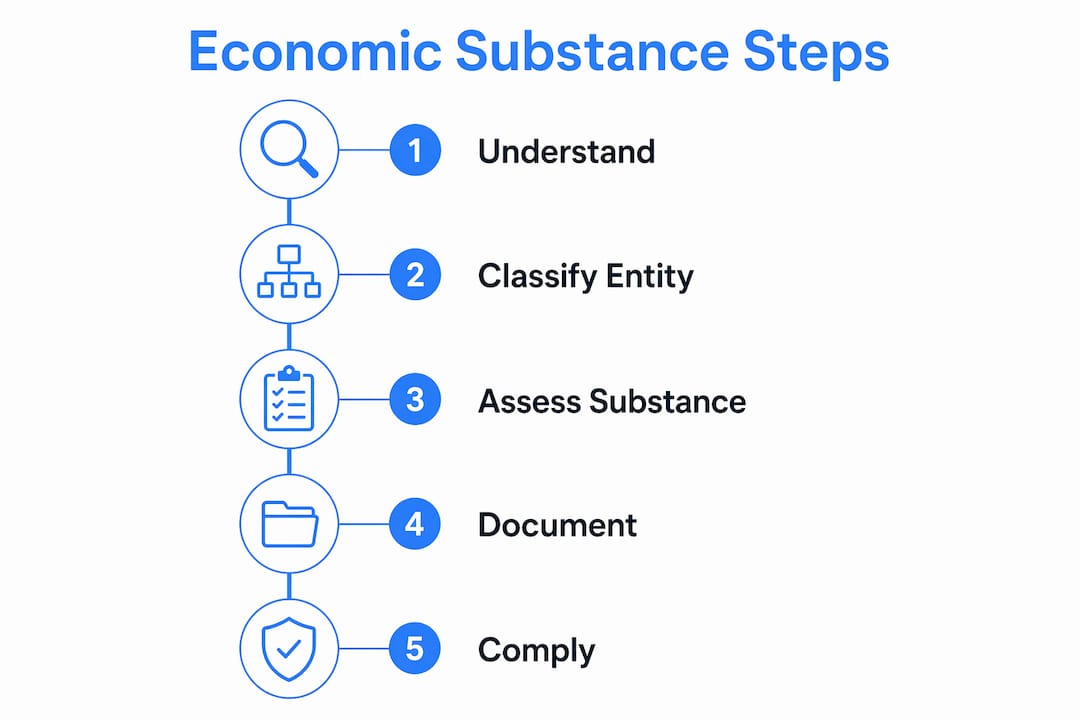
How to meet economic substance: documentation and compliance strategies
Demonstrating adequate substance is fundamentally a documentation exercise. Linking local management, employee expertise, business expenditures, and physical premises to the income streams that generate disposal gains is the core task. Entities that perform the right activities but fail to document them are in nearly the same position as those that do not perform them at all.
The following documentation priorities apply to most covered entities:
- Board and decision records: Maintain board minutes, written resolutions, and delegated authority matrices that show Singapore-based directors making substantive decisions. Strategic control and decision-making location are the most scrutinized factors in any IRAS review. Records should be contemporaneous, not reconstructed after the fact.
- Personnel files: Document the qualifications, roles, and time allocation of individuals performing substance-generating functions. For outsourced arrangements, retain contracts and oversight records that demonstrate Singapore-side control.
- Financial records: Track Singapore-incurred expenditures by category and link them explicitly to income-generating activities. General ledger entries alone are insufficient. Narrative explanations connecting costs to functions strengthen the evidence pack.
- Premises evidence: Lease agreements, utility records, and access logs for Singapore office space demonstrate that the entity occupies real premises. Hot-desking arrangements at a co-working space can qualify if the entity genuinely uses the space for its functions.
| Documentation Type | What to Capture |
|---|---|
| Board minutes | Substantive deliberation, not just approvals; Singapore attendance records |
| Personnel records | Qualifications, role descriptions, time allocation by function |
| Expenditure schedules | Singapore costs mapped to specific income-generating activities |
| Premises records | Lease agreements, access logs, photos of occupied workspace |
| Outsourcing contracts | Scope of services, oversight protocols, review meeting records |
Advance rulings from IRAS offer a powerful risk management tool for entities planning significant foreign asset disposals. Entities planning disposals within one year may apply for an advance ruling that, once granted, is valid for up to five years on the question of economic substance sufficiency. This removes uncertainty from high-value transactions and gives boards the confidence to proceed without the risk of a post-disposal tax assessment. Adept-cs regularly assists clients in preparing advance ruling applications, and the investment in that process is almost always justified when the disposal involves material gains.
What happens if you fail to meet economic substance requirements?
The tax consequence of failing Singapore economic substance requirements is direct and significant. Gains from foreign asset disposals become taxable income upon receipt or deemed receipt in Singapore, subject to the standard corporate income tax rate of 17%. Singapore does not have a formal participation exemption for capital gains in the way that some European jurisdictions do. Foreign-sourced gains have historically fallen outside the tax base because they were treated as capital, not income. Section 10L changes that calculus entirely for entities that cannot demonstrate adequate substance.
"From 1 January 2024, gains from the disposal of foreign assets are taxable when received or deemed received in Singapore if entities lack adequate economic substance." — Corporate Tax Laws and Regulations Report 2026 Singapore
The impact extends beyond the immediate tax liability. Financial reporting for consolidated groups must account for deferred tax positions that may arise if substance adequacy is uncertain. Auditors reviewing Singapore entities post-2024 are increasingly asking for substance documentation as part of their tax risk assessments. Entities that cannot produce it face not only potential tax exposure but also qualified audit opinions and disclosure obligations.
Cross-border structuring decisions made before 2024 may now require revisiting. A holding structure designed when Singapore's capital gains exemption was unconditional may now generate taxable income at the Singapore level if the holding entity lacks substance. Tax professionals advising on Singapore tax residency rules and group restructurings should treat the substance assessment as a mandatory step in any transaction analysis, not an afterthought. The corporate tax implications of getting this wrong compound quickly when disposal gains are material.
Key takeaways
Singapore's economic substance requirements make adequate, documented economic activity in Singapore a prerequisite for tax-exempt treatment of foreign asset disposal gains under section 10L of the ITA.
| Point | Details |
|---|---|
| Section 10L applies from 2024 | Gains from foreign asset disposals are taxable in Singapore without adequate substance. |
| Entity type determines criteria | Pure equity-holding and non-pure equity-holding entities face different substance tests. |
| No fixed numeric thresholds | IRAS assesses substance based on facts, circumstances, and proportionality to business scale. |
| Documentation is the compliance core | Board records, personnel files, expenditure schedules, and premises evidence form the evidence pack. |
| Advance rulings reduce transaction risk | Entities can secure IRAS confirmation of substance sufficiency before completing a disposal. |
Why substance is harder than it looks
Most of the compliance failures I see do not come from entities that ignored the rules. They come from entities that genuinely believed their existing setup was sufficient. A Singapore-incorporated company with a local director, a registered office, and annual filings looks compliant on paper. The problem is that the director attends one board meeting a year, the real investment decisions are made by a parent company in Hong Kong or London, and the Singapore entity's only local expenditure is its annual filing fee.
Section 10L was designed precisely to address that pattern. IRAS is not interested in legal form. It is interested in where economic substance actually sits. The entities that navigate this well are the ones that treat substance as a genuine operational question, not a compliance checkbox. They ask: where are our key people? Where are our decisions made? Where is our money spent? If the honest answer to those questions points outside Singapore, the structure needs to change before a disposal occurs, not after.
I also see a tendency to underestimate the value of advance rulings. Tax professionals sometimes view them as an admission of uncertainty. I view them as the most cost-effective risk management tool available for high-value transactions. A ruling valid for five years gives a board the certainty it needs to execute a disposal strategy without the overhang of a potential tax assessment. For any disposal where the gain is material, the ruling application is worth the time and cost. For guidance on investment holding company structures and their substance implications, the analysis starts well before the disposal date.
— Terence
How Adept-cs can help you meet Singapore's substance rules
Adept Corporate Services works directly with businesses and tax professionals to build and document economic substance in Singapore entities. From corporate setup and secretarial compliance to accounting records that map expenditures to income-generating activities, Adept-cs provides the operational infrastructure that substance assessments require. Our tax compliance services cover IRAS advance ruling applications, substance evidence pack preparation, and ongoing compliance monitoring so your entity stays defensible as regulatory expectations evolve. We also support corporate treasury setup for entities that need to establish or strengthen their Singapore operational footprint. Contact Adept-cs directly. No chatbots, no automated responses. Just experienced professionals who understand what IRAS actually looks for.
FAQ
What is section 10L of Singapore's Income Tax Act?
Section 10L makes gains from the disposal of foreign assets taxable in Singapore when received by an entity that lacks adequate economic substance. The rule applies to disposals from January 1, 2024 onward.
How many employees does a Singapore entity need to satisfy substance requirements?
IRAS sets no fixed employee count. Substance adequacy depends on the entity's business model, scale, and whether the people performing its functions are genuinely based in Singapore with relevant expertise.
Can outsourcing satisfy Singapore economic substance requirements?
Outsourcing core activities to a Singapore-based provider can count toward substance, provided the entity retains documented oversight and control over the outsourced functions under IRAS-specified conditions.
What is an advance ruling and when should you apply for one?
An IRAS advance ruling confirms whether an entity's substance is sufficient before a foreign asset disposal occurs. Entities planning a disposal within one year can apply, and a ruling remains valid for up to five years.
What is the tax rate on gains that fail the substance test?
Gains from foreign asset disposals that fail the economic substance assessment are taxed as ordinary income at Singapore's standard corporate income tax rate of 17%.
Recommended
- 2026 Statutory Compliance Calendar for a Singapore Company | Adept Corporate Services
- Singapore Single Family Office 2026 Guide | Adept Corporate Services
- New Register of Registrable Controllers (RORC) Filing Requirements from 16 June 2025 | Adept Corporate Services
- Singapore Record Keeping Requirements: A Practical Guide to Tax Compliance for Small Businesses | Adept Corporate Services