
A dormant company in Singapore is defined as a company that records no accounting transactions during its financial year, as established under Section 205B of the Companies Act 1967. This definition is more technical than most business owners expect. Dormancy is not simply about pausing operations or having no revenue. It is a precise legal status governed by two separate regulatory bodies, ACRA and IRAS, each with its own criteria, filing obligations, and exemption conditions. Understanding where these frameworks align and where they diverge is the foundation of staying compliant.
What constitutes a dormant company under Singapore law and tax rules?
The Companies Act 1967 applies what practitioners call the "accounting transaction test." A company is dormant if no accounting transaction is entered into its books during the financial year. The moment any accounting transaction occurs, dormancy ceases. This is a stricter standard than many business owners realize, and it is the most common source of unintentional non-compliance.
ACRA and IRAS apply related but distinct criteria. ACRA's definition aligns with the Companies Act accounting transaction test, while IRAS focuses on whether the company has income or is carrying on a business. A company can be dormant under ACRA's definition yet still have tax obligations under IRAS if it holds investments generating passive income. This overlap is where many directors get caught off guard.

The table below compares the two frameworks directly:
| Criterion | ACRA (Companies Act) | IRAS (Income Tax Act) |
|---|---|---|
| Dormancy test | No accounting transactions in financial year | No income and no business activity |
| Passive income impact | Does not automatically end dormancy | Ends dormancy for tax purposes |
| Filing obligation | Annual return required regardless | Tax return required unless waiver granted |
| Exemption available | Audit and financial statement exemption | Conditional tax filing waiver |
| Trigger to end status | Any accounting transaction | Any income or business resumption |
One critical distinction: certain administrative transactions do not end dormancy under the Companies Act. Paying statutory fees, appointing a company secretary, or maintaining a registered address are permitted without triggering active status. This carve-out is deliberate. It allows companies to preserve their legal standing without inadvertently losing dormant status through routine housekeeping.
A common misconception is that a company with a bank account holding idle funds is automatically dormant. If that account earns interest, IRAS may treat the company as having income, which disqualifies it from a tax filing waiver. Dormant status relates to activity level, not registration status. The company remains a live entity on the ACRA register throughout.
What are the filing obligations for dormant companies?
Dormant companies carry real compliance obligations. Many directors assume that inactivity means no paperwork. That assumption leads to penalties.
ACRA obligations are non-negotiable. All companies must file an Annual Return with ACRA, including dormant ones. Deadlines vary based on company type and financial year end. Late filing attracts penalties of up to SGD 600. Persistent defaults escalate to prosecution and potential director disqualification. The 2026 statutory compliance calendar published by Adept Corporate Services provides a clear reference for all relevant deadlines.
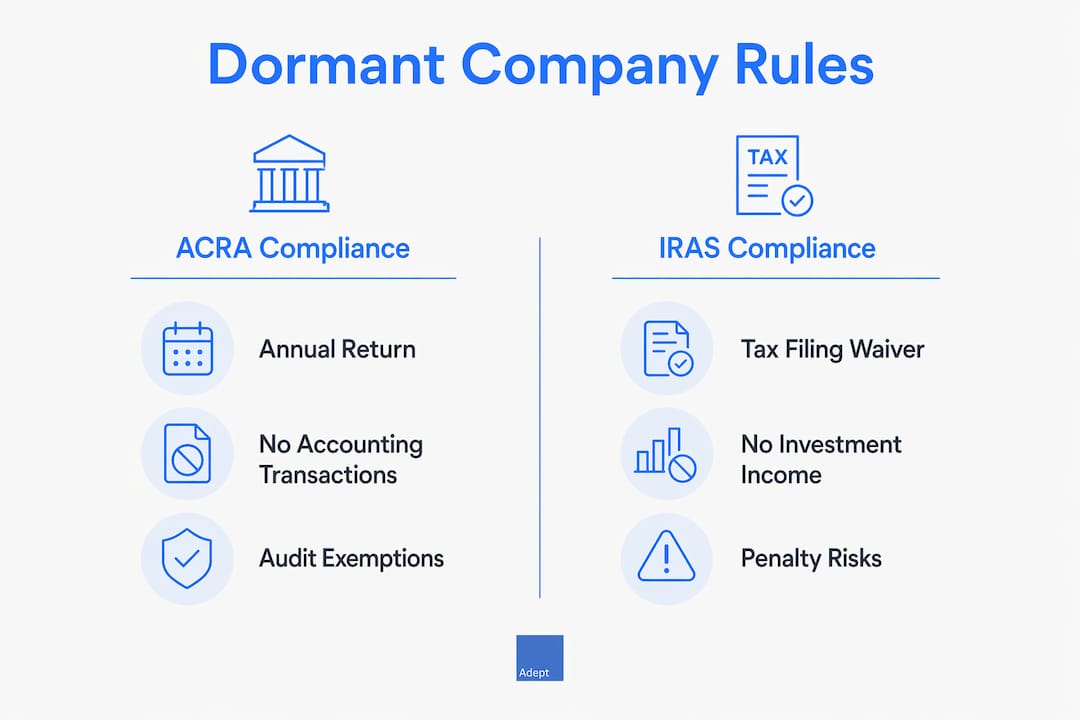
Audit and financial statement exemptions are available but conditional. Under Section 201A of the Companies Act, a dormant relevant company may qualify for both an audit exemption and a financial statement preparation exemption. The conditions include: total assets below S$500,000, no significant accounting transactions during the year, and a directors' declaration confirming dormant status. Meeting all three conditions is required. Missing one disqualifies the company from the exemption.
IRAS obligations follow a separate track. Dormant companies must file corporate tax returns using Form C-S or Form C unless IRAS grants a formal waiver. The waiver is not automatic. To qualify, the company must have no investment income, no intention to resume business in the near term, and must apply to IRAS directly. The waiver is conditional and can be revoked if circumstances change.
The process for maintaining compliance breaks down into four steps:
- Confirm dormant status under both the Companies Act and IRAS criteria before each financial year end.
- File the Annual Return with ACRA by the applicable deadline, regardless of activity level.
- Prepare and submit a directors' declaration if claiming the Section 201A audit and financial statement exemption.
- Apply to IRAS for a tax filing waiver if the company meets all qualifying conditions, and retain documentation of the application and approval.
Pro Tip: Apply for the IRAS tax filing waiver proactively rather than waiting for a tax return notice. IRAS does not automatically grant waivers, and a missed filing deadline while awaiting approval can trigger penalties.
Failure to file required returns can result in penalties ranging from SGD 300 to criminal prosecution for persistent defaults. Directors face personal exposure, including fines and disqualification from serving as a director. The compliance cost of inaction far exceeds the administrative effort of filing correctly.
How to maintain dormant status and avoid common pitfalls
Maintaining dormant status requires active monitoring, not passive neglect. The accounting transaction test is unforgiving. A single transaction recorded in the company's books during the financial year restarts the compliance clock.
The following activities will end dormancy if recorded as accounting transactions:
- Receiving any payment into the company's bank account, including interest
- Making any payment from the company's account, including bank charges
- Issuing or receiving invoices
- Recording any asset purchase or disposal
- Recognizing any income, expense, or liability in the accounts
The following activities are generally permitted without ending dormancy:
- Paying statutory fees directly to ACRA or other government bodies
- Appointing or changing a company secretary
- Maintaining a registered office address
- Filing annual returns and statutory declarations
The distinction matters in practice. Entrepreneurs should monitor what their accounting system logs. A bank charge automatically debited by the company's bank and recorded in the accounts constitutes an accounting transaction. This is one of the most frequent unintentional triggers of active status.
Pro Tip: If your company holds a bank account during dormancy, consider requesting that the bank waive service charges or switch to a zero-fee account structure. This removes one of the most common accidental triggers of accounting transactions.
Coordinating ACRA and IRAS compliance is non-negotiable. A company that files correctly with ACRA but neglects its IRAS obligations faces penalties from IRAS, and vice versa. Both regimes must be satisfied simultaneously. Engaging a qualified company secretary who understands both frameworks reduces the risk of gaps in compliance. The role of the company secretary extends beyond filing. It includes monitoring the company's transaction records and flagging any activity that could affect dormant status.
What are the steps for reactivating a dormant company?
Reactivation is a structured process with specific legal and tax consequences. Business owners who treat it as simply "starting up again" often face unexpected tax obligations and audit requirements.
The reactivation process involves the following steps:
- Notify IRAS within one month of resuming business activity. Reactivation requires notifying IRAS promptly. Failure to do so within the one-month window constitutes a compliance breach and may attract penalties.
- Confirm that any previously granted tax filing waiver is revoked. The waiver ends automatically upon reactivation. The company must resume filing Form C-S or Form C from the year of reactivation onward.
- Update ACRA records if there are any changes to the company's directors, shareholders, or registered address that occurred during the dormancy period.
- Assess audit obligations. Once active, the company must determine whether it qualifies as a small company under the Companies Act for audit exemption purposes. The criteria differ from the dormant company exemption under Section 201A. Adept Corporate Services provides detailed guidance on qualifying for audit exemptions under the small company framework.
- Prepare financial statements for the first active financial year. If the company was previously exempt from financial statement preparation, it must now comply with full reporting requirements under the Companies Act.
When reactivating, IRAS tax filing waivers end, and companies must anticipate possible audits and stricter filing requirements. The timing of reactivation relative to the financial year end affects how many years of returns are required. A company that resumes activity in the final month of its financial year may face a full year's compliance obligations for a period of minimal activity. Planning the reactivation date carefully, in consultation with a corporate services provider, avoids this outcome.
For companies holding investments or assets during dormancy, the reactivation review should also assess whether any passive income received during the dormant period triggers a tax liability. IRAS may require back-filing if investment income was earned but not declared.
Key takeaways
Dormant company compliance in Singapore requires satisfying both ACRA and IRAS obligations simultaneously, with the accounting transaction test under Section 205B being the definitive legal standard for dormancy.
| Point | Details |
|---|---|
| Dormancy definition | No accounting transactions in the financial year under Section 205B of the Companies Act 1967. |
| ACRA filing obligation | Annual returns must be filed regardless of dormant status; late filing penalties reach SGD 600. |
| Audit exemption conditions | Assets below S$500,000, no significant transactions, and a directors' declaration are all required. |
| IRAS tax waiver | Not automatic; requires a formal application and is revoked immediately upon reactivation. |
| Reactivation timeline | IRAS must be notified within one month of resuming business to avoid penalties. |
The compliance gap that catches most dormant companies off guard
From our experience advising business owners across Singapore, the single most consistent error we see is treating dormancy as a passive state that manages itself. Directors park a company, stop trading, and assume the paperwork stops too. It does not.
The ACRA and IRAS frameworks operate independently, and a company that satisfies one without addressing the other is still non-compliant. We have seen cases where a company correctly filed its Annual Return with ACRA for three consecutive years but never applied for an IRAS tax filing waiver. The result was three years of unfiled tax returns, late filing penalties, and a significant administrative effort to regularize the position.
The accounting transaction test is also more granular than most directors appreciate. We have reviewed dormancy declarations that were invalidated by a single bank charge of a few dollars recorded in the company's accounts. The legal standard does not distinguish between material and immaterial transactions. Any transaction ends dormancy.
Our advice is straightforward: treat a dormant company as a live compliance obligation with a reduced workload, not as a company that has been switched off. Review the accounts at least once per quarter, confirm no transactions have been recorded, and maintain a clear paper trail of your ACRA and IRAS filings. If you are considering reactivation, plan the timing carefully and engage professional support before the financial year end to avoid triggering obligations you are not prepared for. The ACRA and IRAS definitions differ in ways that matter practically, and understanding both before you act is the most effective form of due diligence.
— Wandy & Terence
How Adept Corporate Services supports your dormant company compliance
Adept Corporate Services provides end-to-end support for dormant company management in Singapore, covering both ACRA and IRAS obligations. Whether you need to file an Annual Return, apply for a Section 201A audit exemption, or submit an IRAS tax filing waiver application, the Adept team handles the process with precision and without automated responses. Every client works directly with experienced professionals who understand the technical requirements of dormant company regulations in Singapore. For companies preparing to reactivate, Adept's corporate secretarial services and tax compliance support cover the full reactivation process, from IRAS notification to financial statement preparation. Contact Adept Corporate Services directly to discuss your company's specific compliance position.
FAQ
What is the legal definition of a dormant company in Singapore?
A company is dormant under Section 205B of the Companies Act 1967 when no accounting transaction occurs during its financial year. Dormancy ends the moment any accounting transaction is recorded in the company's books.
Do dormant companies still need to file with ACRA?
Yes. All companies, including dormant ones, must file an Annual Return with ACRA by the applicable deadline. Late filing attracts penalties of up to SGD 600, and persistent defaults can lead to prosecution.
How does a dormant company get a tax filing waiver from IRAS?
A company must apply directly to IRAS for a conditional waiver. Qualifying conditions include having no investment income and no intention to resume business in the near term. The waiver is not granted automatically and is revoked upon reactivation.
Can a dormant company qualify for an audit exemption?
Yes, under Section 201A of the Companies Act, a dormant relevant company may qualify if its total assets are below S$500,000, it has no significant accounting transactions, and directors issue a formal declaration. All three conditions must be met.
What happens to the IRAS waiver when a company reactivates?
The tax filing waiver ends immediately upon reactivation. The company must notify IRAS within one month of resuming business and return to standard corporate tax filing obligations, including Form C-S or Form C.
Recommended
- Dormant Company in Singapore: ACRA definition vs IRAS definition & Tax Filing Waivers | Adept Corporate Services
- 2026 Statutory Compliance Calendar for a Singapore Company | Adept Corporate Services
- Singapore Single Family Office 2026 Guide | Adept Corporate Services
- Starting and Setting Up a Business or Company in Singapore | Adept Corporate Services