
Corporate restructuring in Singapore is widely misunderstood. Many executives treat it as a last resort reserved for companies on the brink of collapse. In reality, singapore corporate restructuring explained properly reveals a sophisticated, flexible framework that Singapore has deliberately designed as a strategic tool for business survival, adaptation, and value preservation. Singapore's hybrid restructuring framework blends the US debtor-in-possession model with the English scheme of arrangement, making it one of the most capable systems in Asia. If you lead a company here, understanding this framework is not optional. It is a core leadership competency.
Table of Contents
- Key takeaways
- Singapore corporate restructuring explained: core concepts
- Formal restructuring mechanisms under Singapore law
- Legal, regulatory, and stakeholder considerations
- Practical steps for navigating restructuring effectively
- My perspective on Singapore's restructuring framework
- How Adept-cs supports your restructuring journey
- FAQ
Key takeaways
| Point | Details |
|---|---|
| Restructuring is not just rescue | Singapore's framework supports proactive restructuring as a strategic tool, not only as a response to insolvency. |
| Multiple formal pathways exist | Judicial Management, Scheme of Arrangement, and SIP 2.0 each serve different company sizes and situations. |
| Management control varies by path | Informal workouts and schemes let management stay in place; Judicial Management transfers control to court-appointed managers. |
| Workforce obligations are strict | Employers with 10 or more staff must notify MOM within 5 working days of informing employees about retrenchment. |
| Early professional advice matters | Engaging legal and financial advisors before a crisis gives you more options and better outcomes. |
Singapore corporate restructuring explained: core concepts
Corporate restructuring in Singapore refers to any significant reorganization of a company's financial obligations, operations, ownership, or legal structure to improve its position or address distress. The term covers a wide spectrum, and understanding where your situation falls on that spectrum determines which path makes sense.
At the broadest level, restructuring splits into two categories. Financial restructuring addresses the balance sheet: renegotiating debt terms, converting debt to equity, or reducing liabilities to restore solvency. Operational restructuring focuses on the business itself: divesting non-core assets, reducing headcount, consolidating subsidiaries, or changing the operating model entirely. Many real-world restructurings involve both simultaneously.
The distinction between restructuring and winding up matters enormously. Restructuring assumes the business has a viable core worth preserving. Winding up, whether voluntary or compulsory, is the process of closing the company and distributing its assets to creditors and shareholders. Choosing the wrong path wastes time, destroys value, and can expose directors to personal liability.
Typical scenarios that trigger restructuring consideration include:
- Sustained cash flow deficits despite profitable operations on paper
- A single large creditor threatening enforcement action
- Covenant breaches on bank facilities
- A major contract loss that fundamentally changes the revenue base
- Post-acquisition integration failures creating structural debt problems
- Sector downturns affecting an entire industry simultaneously
Restructuring can also be entirely proactive. Modern corporate leadership in Singapore increasingly treats restructuring as a strategic lever for agility, not just a distress signal. That shift in perspective is what separates companies that survive disruption from those that do not.
Formal restructuring mechanisms under Singapore law
Singapore offers several distinct formal mechanisms, each with specific eligibility criteria, procedural requirements, and implications for management control. Knowing the differences is the foundation of any practical Singapore corporate restructuring guide.
Simplified Insolvency Programme (SIP 2.0)
The SIP 2.0 launched in January 2026 provides two accelerated tracks for eligible micro and small companies. The Simplified Debt Restructuring Programme (SDRP) offers a faster, lower-cost path to restructuring debts without the full complexity of a Scheme of Arrangement. The Simplified Winding Up Programme (SWUP) provides a streamlined route to close a company when restructuring is not viable. Both tracks reduce the time and cost burden that previously made formal processes inaccessible for smaller operators.
Judicial Management
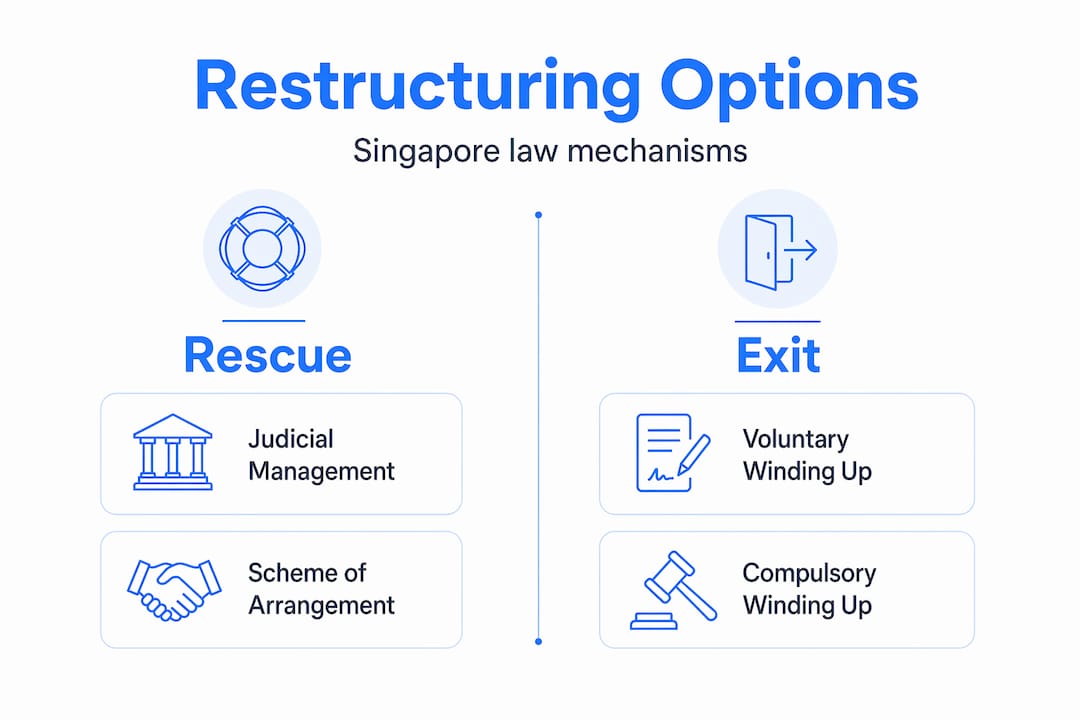
Judicial Management is a court-supervised rescue mechanism. When a company applies successfully, the court appoints a Judicial Manager who takes over operations from existing management. This is a significant control shift. Judicial Management provides a statutory moratorium that protects the company from creditor enforcement actions, giving it breathing room to negotiate a recovery plan. It works best when creditors have lost confidence in the existing management team but still believe the underlying business has value.

Scheme of Arrangement
A Scheme of Arrangement is a court-sanctioned compromise between a company and its creditors or shareholders. In schemes of arrangement, management typically remains in control, unlike Judicial Management. The scheme requires approval from a majority in number representing at least 75% in value of each class of creditors voting, followed by court sanction. It is the preferred vehicle for complex, multi-creditor restructurings where the company wants to preserve its operational leadership.
Voluntary and compulsory winding up
Voluntary winding up is initiated by the company's shareholders when the company is solvent or when creditors agree to a creditors' voluntary liquidation. Compulsory winding up is court-ordered, typically on the application of a creditor owed an unpaid debt. Companies that fail to perform under restructuring plans risk conversion to winding up, which is why compliance monitoring after a restructuring plan is approved is non-negotiable.
| Mechanism | Who controls operations | Court involvement | Best for |
|---|---|---|---|
| Informal workout | Management | None | Early-stage, cooperative creditors |
| Scheme of Arrangement | Management | Approval and sanction | Complex multi-creditor restructurings |
| Judicial Management | Court-appointed manager | Full supervision | Creditor distrust of management |
| SIP 2.0 (SDRP/SWUP) | Management or liquidator | Streamlined oversight | Micro and small companies |
| Compulsory winding up | Court-appointed liquidator | Full court order | Insolvent, no viable rescue |
Pro Tip: If you are considering a Scheme of Arrangement, get creditor temperature checks informally before filing. Courts expect evidence of genuine creditor engagement, and a scheme that surprises major creditors rarely succeeds.
Legal, regulatory, and stakeholder considerations
Understanding how corporate restructuring works in Singapore means understanding the obligations that run alongside it. Restructuring does not suspend your legal duties as a director or employer. In fact, it intensifies scrutiny of how you discharge them.
Director duties and insolvency timing
Directors in Singapore have a duty to act in the interests of creditors once a company is insolvent or near-insolvent. Continuing to trade while knowingly insolvent without a genuine restructuring plan exposes directors to personal liability for insolvent trading. The timing of when a director recognized or should have recognized insolvency is often the central question in post-restructuring litigation. Document your decision-making process carefully and contemporaneously.
Workforce restructuring obligations
Retrenchment during restructuring triggers specific compliance requirements. Employers with 10 or more employees must notify the Ministry of Manpower within 5 working days after informing affected employees. The prevailing industry norm for retrenchment payment runs from 2 weeks to 1 month of salary per year of service. Critically, there is no statutory obligation for retrenchment payment in Singapore, but any contractual or collective agreement terms must be honored. Breaching these norms does not just create legal risk. It destroys morale among retained staff at exactly the moment you need them most.
Key creditor and regulatory obligations during restructuring include:
- Providing accurate and timely financial disclosures to creditors throughout the process
- Complying with any moratorium conditions imposed by the court
- Notifying ACRA of material changes to the company's registered information
- Keeping the Official Receiver informed if a formal insolvency process is underway
- Monitoring compliance with recent regulatory filing changes that affect controller disclosure obligations
Singapore is recognized as a leader in insolvency reform, having integrated tools like the SIAC Restructuring and Insolvency Arbitration Protocol to improve dispute resolution between creditors and debtors. That institutional strength benefits companies restructuring here, but only if they engage with the system properly.
Practical steps for navigating restructuring effectively
The corporate restructuring process in Singapore rewards preparation. Companies that arrive at a formal process having already done the groundwork move faster, spend less, and achieve better outcomes. Here is how to approach it strategically.
-
Assess solvency and act early. Run a clear-eyed cash flow analysis covering at least 12 months forward. If you see a solvency problem forming, act before it becomes a crisis. The earlier you engage, the more options you have and the less leverage creditors hold.
-
Engage qualified advisors before filing anything. Restructuring law in Singapore is technically demanding. The hybrid system requires procedural discipline and high expertise from both legal and financial advisors. Attempting a Scheme of Arrangement without experienced counsel is a common and expensive mistake.
-
Get your financial records audit-ready immediately. Foreign investors frequently underestimate restructuring costs because their initial bookkeeping does not meet audit standards. Reconstructing financial records mid-process is slow and signals poor governance to creditors and courts. Establish audit-ready financial reporting from day one.
-
Plan stakeholder communications deliberately. Creditors, employees, customers, and regulators all need different messages at different times. Silence creates rumors. A structured communication plan reduces defection by key customers and staff during the process.
-
Choose your restructuring vehicle based on facts, not preference. Many companies default to informal workouts because they fear losing control. That preference is understandable, but it is not always rational. If creditors are hostile or management credibility is damaged, Judicial Management may actually accelerate resolution and preserve more value than a prolonged informal negotiation.
-
Build a compliance monitoring system from day one. Once a restructuring plan is approved, execution is everything. Non-compliance converts restructuring into winding up. Assign clear ownership of every milestone in the plan and report against it regularly.
Pro Tip: Engage your corporate finance advisory team before you approach creditors. Arriving at the first creditor meeting with a credible, professionally prepared restructuring proposal dramatically improves your negotiating position.
My perspective on Singapore's restructuring framework
I've worked with companies across a range of industries navigating restructuring in Singapore, and the pattern I see repeatedly is this: the companies that struggle most are not the ones with the worst financial problems. They are the ones that waited too long to get professional help and then tried to manage the process internally to save costs.
Singapore's hybrid model is genuinely one of the best-designed restructuring frameworks in the world. The combination of debtor-in-possession flexibility and court-supervised protection gives companies real options. But that sophistication cuts both ways. The procedural requirements are exacting, and the courts expect a high standard of disclosure and good faith from applicants.
What I've found is that the benefits of corporate restructuring in Singapore are only fully realized when leadership treats the process as a structured project with professional oversight, not a negotiation they can wing. The companies I've seen come through restructuring in the strongest position all had one thing in common: they engaged advisors early, maintained transparent communication with creditors, and treated compliance as non-negotiable throughout.
The 2026 SIP 2.0 reforms are a genuine improvement for smaller companies. For the first time, micro and small businesses have a realistic formal pathway that does not require the legal budget of a mid-market company. That is a meaningful shift in who can access Singapore's restructuring system effectively.
— Terence
How Adept-cs supports your restructuring journey
Corporate restructuring demands more than legal advice. It requires coordinated support across secretarial compliance, accounting, tax, and regulatory obligations, all running in parallel under time pressure. Adept-cs provides exactly that kind of integrated support for businesses in Singapore navigating complex transitions. Whether you need help maintaining corporate secretarial compliance during a restructuring process, ensuring your financial records meet audit standards, or understanding your regulatory obligations at each stage, our team works directly with you. No automated responses, no handoffs to junior staff. If you are assessing your options or ready to act, explore our corporate services overview or contact us directly for a consultation.
FAQ
What is corporate restructuring in Singapore?
Corporate restructuring in Singapore is the reorganization of a company's financial obligations, operations, or structure to improve its position or address distress. It encompasses informal debt workouts, formal court-supervised processes like Judicial Management and Schemes of Arrangement, and streamlined paths under SIP 2.0 for smaller companies.
What is the difference between Judicial Management and a Scheme of Arrangement?
Judicial Management transfers operational control to a court-appointed manager and provides a statutory moratorium against creditor action. A Scheme of Arrangement allows management to remain in place while negotiating a court-sanctioned compromise with creditors, requiring approval from a majority representing at least 75% in value of each creditor class.
What are the retrenchment notification requirements during restructuring?
Employers with 10 or more employees must notify the Ministry of Manpower within 5 working days of informing employees about retrenchment. While there is no statutory retrenchment payment obligation in Singapore, contractual and collective agreement terms must be honored, and industry norms run from 2 weeks to 1 month of salary per year of service.
What is SIP 2.0 and who qualifies?
SIP 2.0, launched in January 2026, provides accelerated restructuring and winding up paths specifically for eligible micro and small companies in Singapore. It includes the Simplified Debt Restructuring Programme and the Simplified Winding Up Programme, both designed to reduce the cost and complexity of formal processes for smaller operators.
When should a company start the restructuring process?
The optimal time to begin restructuring is before a liquidity crisis becomes acute. Directors should act once they identify sustained cash flow deficits, covenant breaches, or creditor pressure, because early engagement preserves more options, reduces costs, and limits personal liability exposure for the board.
Recommended
- New Register of Registrable Controllers (RORC) Filing Requirements from 16 June 2025 | Adept Corporate Services
- Singapore Single Family Office 2026 Guide | Adept Corporate Services
- Starting and Setting Up a Business or Company in Singapore | Adept Corporate Services
- A Complete Guide to Corporate Services and Company Formation in Singapore | Adept Corporate Services